Meta Creative Diversity: What It Is and How the Score Works
What creative diversity means on Meta, how the new Creative diversity score in Ads Manager works, what it misses, and how to test ahead of it.

Short answer
Creative diversity on Meta means running ads that are genuinely different in visuals, message and format, so Meta's ads system can match different ads to different people. Meta treats ads that look or feel alike as variations of one creative. Since August 2026, Ads Manager has a Creative diversity column that labels each ad set High, Medium or Low by comparing its images and video thumbnails. It is still in development and Meta's definition does not mention copy, audio or offers, so use it as a prompt and test new looks and angles yourself.
Key takeaways
- Meta's Creative diversity column labels each ad set High, Medium or Low by "comparing the images and video thumbnails in your ad set to each other to determine similarity", according to Meta's help article, checked November 19, 2026.
- Meta marks the metric "estimated and in development" and publishes no thresholds or effect on delivery, so treat a Low label as a reason to check an ad set, not a verdict.
- Meta explained in December 2025 that its ads system groups ads that "look or feel alike" as variations of the same creative, but the first ad set level diversity label, the Creative diversity column, only appeared in August 2026, and it reads pictures, not themes.
- That gap between what the system rewards and what Meta makes measurable is where the edge is: teams that run their own tests learn which kinds of variety pay off before a dashboard tells everyone.
- By Meta's definition, the score should move when ads look different (new people, settings, formats and opening frames), while new angles, offers and scripts still matter to buyers even though the score is not described as reading them.
Meta now grades creative variety in Ads Manager, but the more useful story is the gap behind that grade. Meta described how it groups look-alike ads well before it gave advertisers a label for an ad set's variety, and the column still measures only part of what Meta says its system reacts to. Teams that test their way through that gap learn what works first. This guide covers the gap and how to use it, then everything about the score itself, and ends with an audit you can start today.
What is creative diversity on Meta?
Meta defines creative diversification as "the practice of creating a wide range of ad creatives with different themes, messages, and visuals to cater to diverse audience segments" (Meta for Business, April 2025). In the same post, Meta says "the focus has shifted from niche targeting to creative diversification as the best lever to find the most relevant audiences." With broad targeting, your ads do the targeting: different creative reaches different people.
Meta separates this from creative iteration. In its December 2025 guide, iteration "might produce two ads with identical visuals, but different text CTAs", while diversification produces distinctly different pieces of creative, such as a Reels ad made for one audience and a creator partnership ad made for another. Iteration tests small changes; diversification gives the system different ads to choose from.
Why it matters: Meta says its ads system "groups together ads that share key visual and thematic attributes" and treats them as variations of the same creative. So ten near-copies of one ad give the system fewer real options than ten different ads. The Creative diversity column is Meta's first label for one part of that: how alike the images and video thumbnails in an ad set look.
The measurement gap: Meta explained it first
Meta described how its system treats look-alike creative years before it gave advertisers a diversity label. Until then, the closest signals were fatigue statuses for repeats of the same image or video and, from late 2025, a similarity insight for static ads. Line up Meta's statements and the pattern is clear:
| When | What Meta said or shipped | What you could measure |
|---|---|---|
| May 2023 | Meta's analytics team tracked exposures "at the level of the creative rather than the ad", noting people can tire of "similar versions of the same creative" | Frequency per ad, plus Creative fatigue statuses for repeats of the same image or video; nothing for look-alike versions |
| November to December 2024 | Meta recommended "at least 20 diversified ads" in Advantage+ shopping campaigns, and explained Andromeda, the stage that narrows tens of millions of ads to a few thousand | No measure of how diverse those ads were; fatigue statuses still covered only repeats of the same image or video |
| December 2025 | Meta said its system "groups together ads that share key visual and thematic attributes" and treats them as one creative | Fatigue statuses, plus expanded fatigue and similarity insights Meta said it was still testing |
| August 2026 | No announcement found | The Creative diversity column, "estimated and in development", reading images and video thumbnails only |
| September 2026 | A Meta spokesperson: "We don't get into the specifics of how our ranking models represent individual creative assets" | Creative insights in the Insights API, tested with "a small number of agencies/GCR resellers" since June and "not widely available" |
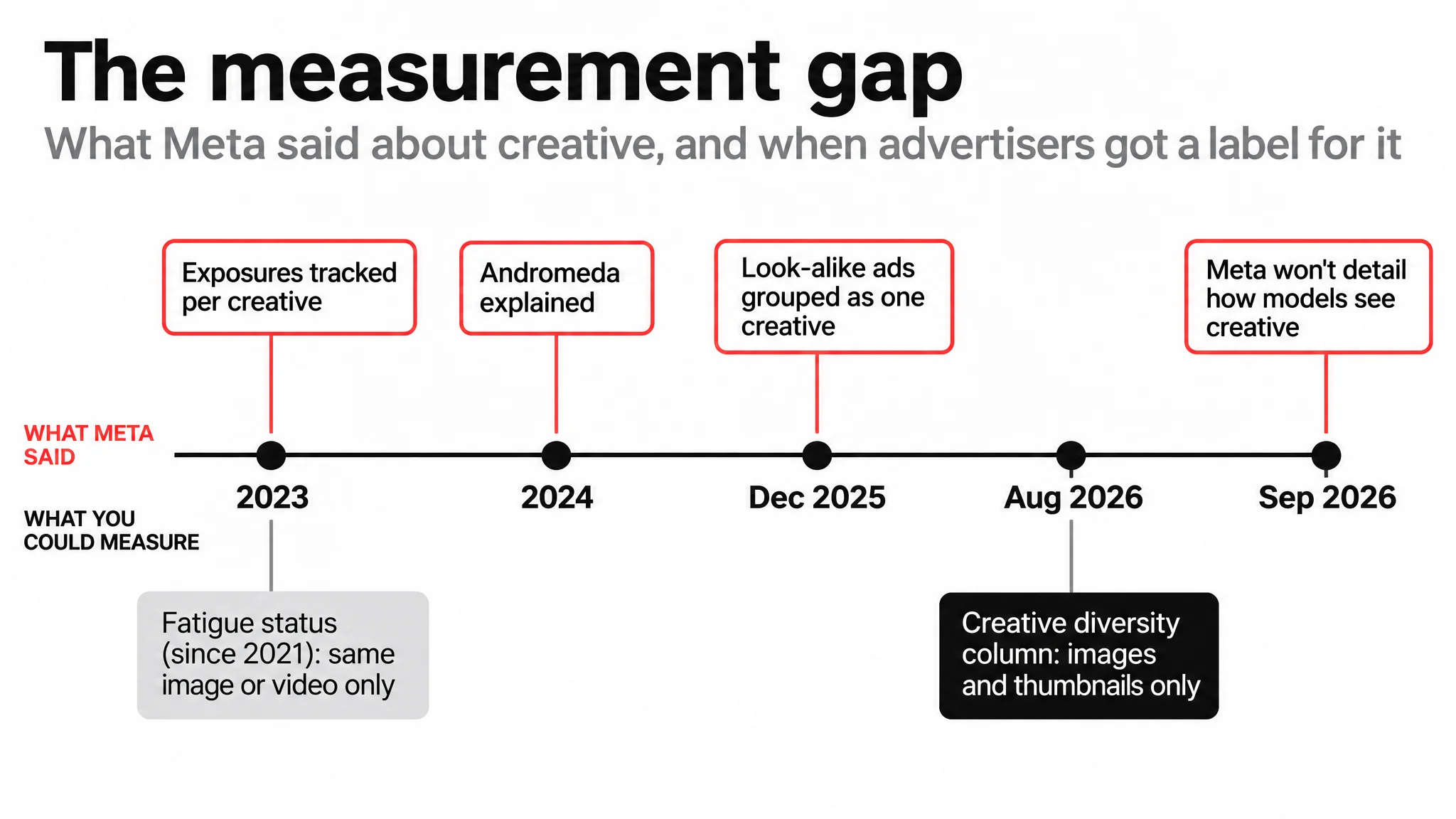
Two gaps stand out. The first is time: Meta explained in December 2025 that look-alike ads are grouped, and the Creative diversity column, the first label that rates a whole ad set's variety, arrived about eight months later. The second is scope: Meta says it groups ads on "visual and thematic attributes", but the column reads only images and video thumbnails, so it says nothing about the thematic half. Account insights shows your top creative themes, but not whether Meta groups your ads by them. And Meta has said, on the record to Marketing Brew, that it won't detail how its models represent creative, so the full picture may never be published.
Where the edge is: test before Meta measures it
When the system changes before the dashboard does, the teams that learn fastest run their own tests instead of waiting for a metric. Meta's own advice points the same way: a Meta spokesperson summed up its guidance to Marketing Brew as "diversify your creative, test, and let the system optimize." You do not need inside knowledge, just clean comparisons and numbers Ads Manager already shows: reach, frequency, CPM and cost per result.
| Question | Test | What to compare |
|---|---|---|
| Does Meta treat my variations as one creative? | Two ad sets, same budget and audience: one with five versions of one visual, one with five visually distinct ads for the same offer | Reach, frequency and cost per result after a week |
| Does the column read my videos, or only their thumbnails? | The thumbnail test in the video section below | The two labels |
| Do new angles help when the pictures look alike? | One visual with five different angles in copy and voiceover, against five different visuals | Cost per result and reach; the column likely won't move for the first |
| Does the label predict anything in my account? | Log each ad set's label weekly next to its cost per result | Whether Low ad sets drift worse over time; note any jump across all ad sets at once, which points to a change on Meta's side |
Use Meta's built-in A/B testing where you can: it shows each version to a separate part of your audience so nobody sees both. Treat one result as a lead, not a rule. What you learn in your own account is the advantage: if Meta publishes a fuller metric, you will already know which kinds of variety pay off for you.
What is the Creative diversity column in Meta Ads Manager?
Meta's help article, titled "Creative diversity", defines the metric in two sentences:
"Creative diversity is calculated by comparing the images and video thumbnails in your ad set to each other to determine similarity. This is converted into a score and given a label of High, Medium, or Low by applying thresholds."
The same page gives its purpose: "Creative diversity is used to determine if more varied images and videos need to be added to an ad set to help prevent creative fatigue and improve performance." It also says plainly: "This metric is estimated and in development."
We found no Meta announcement of the column. The earliest dated coverage we found is Search Engine Land on August 26, 2026, which said Meta had rolled it out "earlier this month", and an archived copy of Meta's help page dates from September 25, 2026. It is not new this month, but practitioners still report accounts that do not have it yet.
How to find the Creative diversity column
- Open Ads Manager and go to your ad sets. Practitioners see the label at the ad set level; Meta's definition also mentions an account ID.
- Click Columns, then Customize columns.
- Search for "diversity" and tick Creative diversity.
- Save the column set as a preset so the column stays in the view you use to set budgets.
Meta's help article does not document this path; it is the route Search Engine Land and other practitioners report. If the search returns nothing, the column has most likely not reached your account. Meta has not said which accounts have it.
What the creative diversity score measures, and what it does not
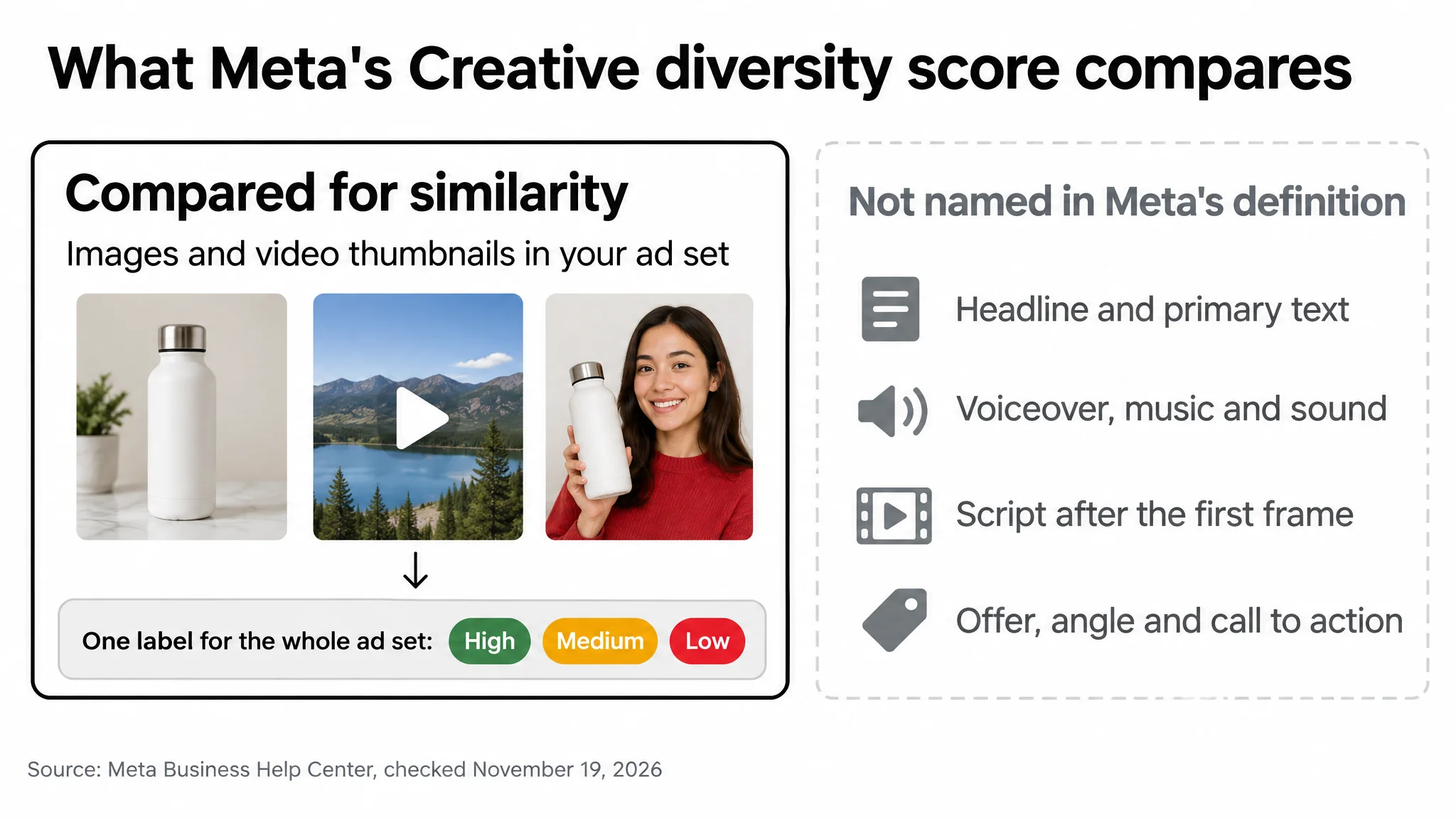
The definition names two inputs and one comparison. The rest is unstated or unpublished:
| Question | What Meta says |
|---|---|
| What is compared? | "the images and video thumbnails in your ad set", against each other |
| What are the thresholds? | Not published. Only "by applying thresholds". |
| Does copy or the headline count? | Not stated. Copy is not named as an input, so new text on the same picture should not move the label. This is an inference. |
| Which video frame is the thumbnail? | Not stated. |
| Does Low change delivery or costs? | Not stated. The article describes a diagnostic. |
| Is the metric final? | No. "This metric is estimated and in development." |
The last row matters most. Meta's page on estimated and in-development metrics says businesses can use in-development metrics for "Directional guidance", but "shouldn't" use them for "Historical comparison of advertising performance" or "Strategic planning or important business decisions." Creative diversity is labelled in development, so that stricter rule applies: use the label to decide where to look, not to move budget on its own.
Creative diversity vs creative similarity vs creative fatigue
Meta shows three related signals in three different places. They measure different things, and mixing them up leads to the wrong fix.
| Signal | Where you see it | What it measures | Meta's suggested fix |
|---|---|---|---|
| Creative diversity | A column in Ads Manager, per ad set | How alike the images and video thumbnails in one ad set are | Add more varied images and videos |
| Creative similarity | Account insights in Meta Ads Reporting | When "the images or videos in your ads appear too visually identical", based on static ads active in the last 28 days | "creating new ads with unique creative" |
| Creative limited and Creative fatigue | Delivery column, per ad set or ad | Repeat exposures of the image or video, plus cost per result against your past ads: limited when higher but under twice as much, fatigue at twice or more | A new image or video "materially different from the original creative", keeping the original running |
Meta draws the line itself in its December 2025 guide to creative diversification: "fatigue is about overexposure, while similarity is about a lack of visual diversity." Its fatigue status counts "all recent exposures of the ad's image or video, including those from other campaigns from your Page", so one hero image reused across campaigns can fatigue all of them together.
Why is my creative diversity Low?
Because the score compares pictures, an ad set scores Low whenever its images or thumbnails look alike, however different the ads feel to you. The usual causes:
- One creator, one set or one hero shot across most of the ads. The scripts vary, but the frame looks the same.
- Iterations of one winner: the same image with a new headline, button or text overlay. Meta calls this creative iteration, which "might produce two ads with identical visuals, but different text CTAs", not diversification.
- Videos that open on a similar frame, such as a creator talking to camera in the same room. If the score reads thumbnails, the rest of the video is invisible to it.
- Possibly strict thresholds. Search Engine Land contributor Akvile DeFazio reported that several accounts she was confident were varied, using "static images, video ads, videos with a variety of hooks and people, user-generated content, partnership ads, boosted brand organic posts, and carousels", were each rated Low. She said that may reflect "the metric's early stage, stricter-than-expected thresholds, or signals Meta hasn't disclosed."
That last point is why a Low label is a reason to look, not proof that something is wrong.
Does a Low creative diversity score hurt delivery?
Meta has not said the label itself changes delivery, costs or ranking. Several articles claim a Low score suppresses reach; none we read cites Meta for it.
What Meta said in its December 2025 guide is that its ads system "analyzes creatives and groups together ads that share key visual and thematic attributes. When multiple ads look or feel alike, these are seen as variations of the same creative." Its creative differentiation page goes further: "When creative is too similar, our system may not recognize it as different and could deliver it to the same sets of audiences. This overlap limits your reach and ultimately leads to Creative limited or Creative fatigue status."
So the column is a warning light for something Meta does say costs you: look-alike ads reaching the same people. Meta's 2023 analytics study adds a number. Tracking repeat exposures at the level of the creative rather than the ad, it found that "at 4 repeated exposures the associated likelihood of a conversion drops by about 45%", and that repetition works best spread "across a large number of different looking ads". The 45% figure is an association. A follow-up split test across about 26,000 cases found that adding new creative to fatigued ad sets improved conversion rates. Neither is a test on your account.
The video blind spot
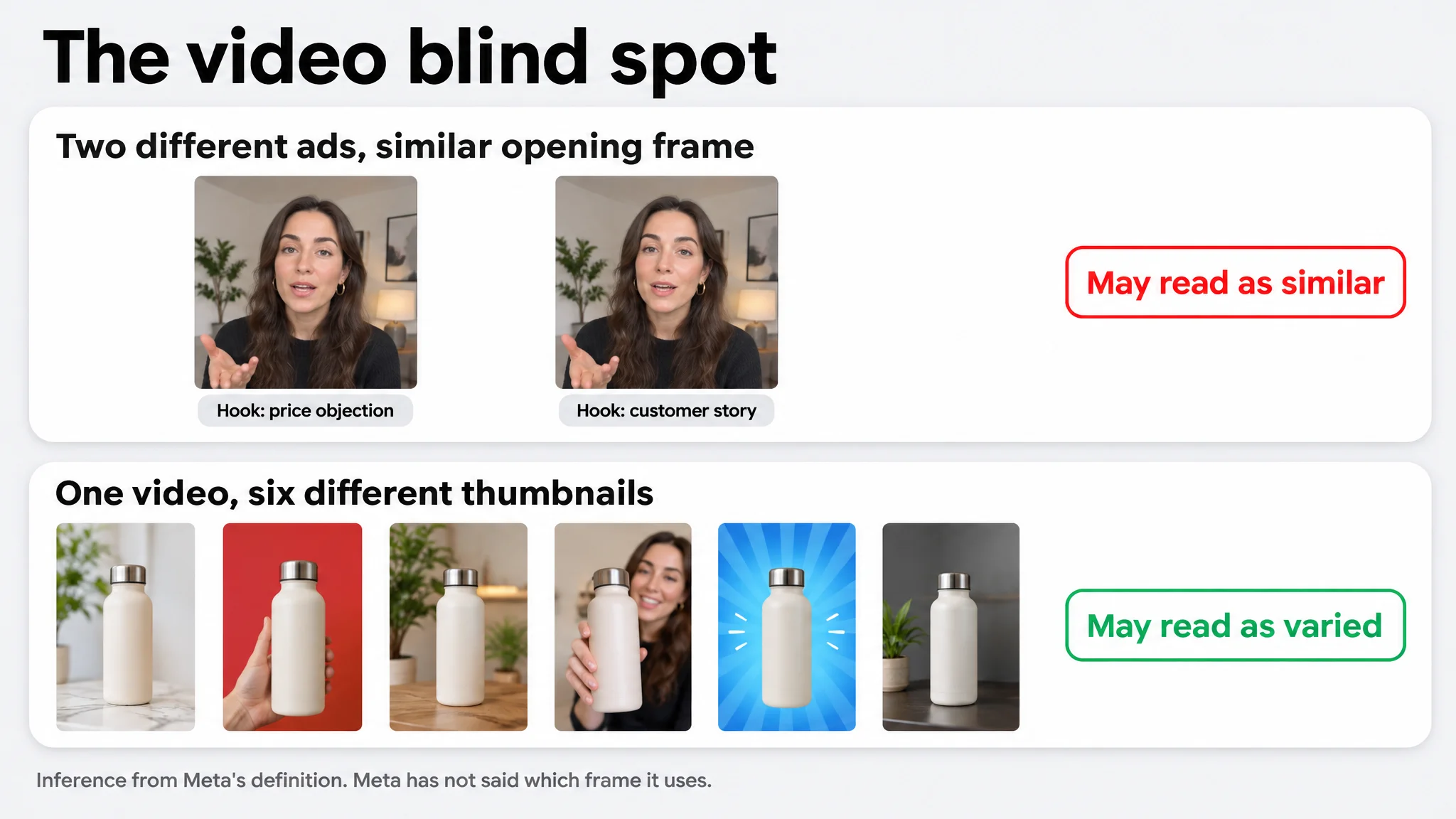
Meta's definition mentions video thumbnails, not the video. If that is all the score reads, it can misjudge video ad sets both ways. As Peter Quadrel put it on LinkedIn, two videos with different hooks, messages, edits and offers "can share a similar first frame and still score Low", while "ten cuts of the same video with different thumbnails could score High."
Meta has not confirmed which frame it treats as the thumbnail, so check before acting on it. A test you can run:
- Pick a video-heavy ad set rated Low and note the label.
- Duplicate it, and in the copy give each video a clearly different custom thumbnail, changing nothing else. Give the copy a small budget for a few days: it spends money and overlaps the original's audience.
- Compare the two labels once both ad sets have delivered.
- If the copy moves up, the score is responding to thumbnails, which suggests it gives little weight to what happens inside your videos. One test is not proof: labels can also shift as delivery changes, so repeat it on a second ad set before you rely on it.
How to increase creative diversity in Meta ads
Split the fixes into two kinds: changes the score can see, and changes only people can see. You need both. Meta's creative differentiation page puts it well: "While the system needs different formats to thrive, your audience needs different reasons to care."
| Change | Should it move the score? | Why it matters |
|---|---|---|
| A different person on camera: creator, age, setting | Should, the picture changes | Meta's creative diversification cheat sheet lists "Talent diversity" |
| A new format: static, short video, carousel, Reels, partnership ad | Should, if the picture changes | Meta's lesson: "a single concept can become a video, static image or a reel" |
| A new production style: lo-fi creator video, polished product shot, graphic or animation | Should, if the picture changes | Both lo-fi and polished styles are on Meta's cheat sheet |
| Different product shots: hero, multi-product, people with product | Should, if the picture changes | Cheat sheet: "Product diversity (hero + multi-product)" |
| A new first frame or custom thumbnail on a genuinely different video | Likely, if the score reads thumbnails | Lets the score see variety your videos already have |
| A new angle: price, performance, ease of use, social proof | Not by itself | Gives people different reasons to care |
| A new headline, offer or button on the same image | Should not | Useful for testing, but Meta treats it as the same creative |
| A new script or voiceover over the same shot | Unlikely | Matters to viewers; the score may not see it |
The practical move is to pair the two: take an angle that already converts and put it into a person, setting and format it has never run in. Meta's December 2025 guide asks for ads "truly different in look, feel, storyline, and message", not "small, subtle tweaks to the same ad".
Keep judging creative on the usual numbers too: click-through rate, hook rate, retention and cost per result. The label tells you how varied an ad set looks, not which ads work. Our short-form video benchmarks and guide to hooks cover the engagement side.
How many creatives per ad set does Meta recommend?
Meta's own numbers point in different directions, so here they are side by side:
| What Meta says | Source |
|---|---|
| "at least 20 diversified ads in Advantage+ shopping campaigns", with 20 to 30% of budget for testing new ads | Meta for Business, November 19, 2024 |
| "Decrease ads per ad set, but maintain diverse creative assets per ad set. One ad can contain multiple (up to 10) creative assets." | Meta help article on ad volume, live November 19, 2026 |
| "too many ads can result in worse performance", because each ad delivers less often and fewer exit the learning phase | Same help article |
| A maximum of 50 non-archived ads per ad set | Marketing API reference |
| No fixed number: build "a broad portfolio of assets" instead of "a fixed volume of ad creatives per campaign" | Meta for Business, December 16, 2025 |
Read together, Meta wants many different-looking assets, but not so many ads that each gets too little delivery to learn. A reasonable reading is fewer ads per ad set, each carrying several genuinely different assets. We found no Meta source for the "10 or more creatives per campaign" figure that circulates online.
Claims about the score to ignore
| Claim you will see (paraphrased) | What the sources say |
|---|---|
| Exact similarity cut-offs, such as above 60% merges ads, under 40% is safe, or 70% of the frame must change | Meta publishes no thresholds or percentages. |
| It rates visual and thematic variety, including hooks and messaging | The column definition names images and video thumbnails only. "Thematic" comes from how Meta describes its delivery system grouping ads. |
| A Low score suppresses delivery | Meta has not said this. |
| Meta recommends 10 or more creatives per campaign | We found no Meta source for it. See Meta's numbers above. |
| Meta has no help page for it | It does: "Creative diversity" in the Meta Business Help Center. |
| Meta gives each look-alike group an Entity ID | Not in any public Meta documentation. One vendor quotes a Meta rep calling it internal-only, so nothing about how it works can be checked. |
| It launched on August 26 | That is Search Engine Land's publish date. Meta has not announced a date that we could find. |
Creative diversity checklist: audit your ad sets
The first five steps take about 15 minutes. The rest is the follow-through.
- Add the Creative diversity column to your ad set view and sort by amount spent.
- Mark every ad set rated Low that takes a meaningful share of spend. Those come first.
- Open each one and line up its images and video thumbnails side by side. Count genuinely different pictures, not ads.
- Check the same ads for Creative limited or Creative fatigue delivery statuses.
- In Account insights, if your account has it, check the Creative similarity insight for your static ads from the last 28 days.
- For each Low ad set, list the angles that already convert, and plan one new person, setting or format for each.
- Give genuinely different videos distinct opening frames or custom thumbnails.
- Add the new ads without pausing the originals, as Meta suggests for fatigued creative.
- Recheck the label and your cost per result after the new ads have delivered, and keep the change only if results hold.
Where Fastlane fits
Testing ahead of Meta and raising creative diversity both depend on production: you need more visually different ads from the few ideas that already work, fast enough to run the comparisons above. Fastlane turns a website URL into AI UGC videos, slideshows, wall-of-text videos and hook and demo videos, with over 1,000 AI UGC characters, so one angle can be rebuilt with different people and formats without booking a new shoot. See our AI advertisement generator guide, or start with what UGC is if creator-style ads are new to you.
Frequently asked questions
What is creative diversity in Meta ads?
Creative diversity is a metric in Meta Ads Manager that labels an ad set High, Medium or Low by comparing how similar its images and video thumbnails are to each other. Meta says it is used to tell you when an ad set needs more varied images and videos to prevent creative fatigue.
What is creative diversification on Meta?
Meta defines creative diversification as creating a wide range of ad creatives with different themes, messages and visuals for different audience segments. Meta says the focus has shifted from niche targeting to creative diversification as the best lever to find the most relevant audiences.
What is the difference between creative diversification and creative iteration?
Creative iteration changes small things on the same ad, such as a new text CTA on identical visuals. Creative diversification makes distinctly different ads, with different visuals, messages or formats. Meta treats iterations as variations of the same creative.
Why does Meta want more creative diversity?
With broad targeting, Meta relies on creative to reach different people. Its ads system groups ads that look or feel alike as one creative, so a set of near-copies gives it few real options, while genuinely different ads let it match different ads to different audiences.
Where is the Creative diversity column in Ads Manager?
Practitioners find it under Columns, then Customize columns, by searching for "diversity" and ticking Creative diversity. Practitioners see it at the ad set level. Meta's help article does not document the path.
Why can't I see the Creative diversity column?
Meta has not said which accounts have the column, and practitioners report uneven availability since it appeared in August 2026. If searching Customize columns for "diversity" returns nothing, it has most likely not reached your account yet.
Does changing the headline improve creative diversity?
Not by Meta's definition. The score compares images and video thumbnails, so new copy, a new headline or a new call to action on the same picture should not change the label. Meta calls that kind of change creative iteration, not diversification.
Does a Low creative diversity score hurt performance?
Meta has not said the label itself changes delivery or costs. It has said that ads which look alike are treated as variations of one creative and can reach the same people, which limits reach and can lead to Creative limited or Creative fatigue status.
What thresholds does Meta use for High, Medium and Low?
Meta does not publish them. Its help article says only that the similarity score is labelled "by applying thresholds". Percentages such as 40%, 60% or 70% that appear online come from agencies and vendors, not Meta.
How many ads should a Meta ad set have?
Meta gives no single number. Its current help article says to decrease ads per ad set while keeping diverse assets, with up to 10 assets in one ad, warns that too many ads can hurt performance, and the API caps an ad set at 50 ads.
What does Meta Andromeda have to do with creative diversity?
Andromeda is Meta's ad retrieval system, the first stage that narrows tens of millions of ad candidates to a few thousand before ranking. Meta says its system groups ads that look or feel alike as variations of one creative, so ads that are distinct in their visuals, messaging and formats give it more real options to choose from. Meta has not said the Creative diversity column measures that grouping directly.
Can AI-generated ads raise creative diversity?
Only if the outputs look genuinely different, with different people, settings and formats, rather than recoloured copies of one image. Meta reports that campaigns using its own image generation feature in Advantage+ creative saw an 11% higher click-through rate and 7.6% higher conversion rate on average than campaigns without it. These are Meta's figures for its own tool, not a controlled test, and they say nothing about other AI tools.
Sources
- Meta Business Help Center: Creative diversity
- Meta Business Help Center: About estimated, in development and third-party metrics
- Meta Business Help Center: About Account insights in Meta Ads Reporting
- Meta Business Help Center: About creative fatigue recommendations in Meta Ads Manager
- Meta Business Help Center: About managing ad volume
- Meta for Business: Demystifying Creative Diversification (December 16, 2025)
- Meta for Business: Creative differentiation best practices
- Meta for Business: Creative diversification cheat sheet (PDF)
- Meta for Business: Creating diverse Meta advertising campaigns (lesson)
- Meta for Business: Three steps to optimize your performance with creative diversification (November 19, 2024)
- Meta for Business: The Creative Advantage, diversification with Meta Andromeda (April 22, 2025)
- Meta for Business: AI innovations in Meta's ads ranking (March 27, 2025)
- Engineering at Meta: Meta Andromeda (December 2, 2024)
- Analytics at Meta: Creative fatigue and repeated exposures (May 10, 2023)
- Meta Marketing API: Ad set reference (limits)
- Search Engine Land: Meta Ads, why creative diversity matters more than volume (August 26, 2026)
- Marketing Brew: How advertisers are adjusting to Meta's ad creative diversification best practices (September 28, 2026)
- Peter Quadrel on LinkedIn: the new Creative diversity column (November 18, 2026)