Kling 4.0 Explained: 30-Second AI Video for Marketers in 2026
Kling 4.0 is Kuaishou's new AI video model, officially launched on 15 October 2026, and it generates clips of up to 30 seconds in one pass with up to 10 keyframes and 15 references. Here is what it does, what is live versus coming soon, and how to use it for TikTok, Reels and Shorts.
Key takeaways
- Kling 4.0 is Kuaishou's next-generation AI video model, officially launched on 15 October 2026 after a Kling 4.0 Flash closed beta that opened on 28 September 2026.
- Kling 4.0 generates clips of up to 30 seconds in a single pass, double the 15-second maximum of Kling 3.0.
- Kling 4.0 accepts up to 10 keyframes and up to 15 references (images, videos, subjects and voices) in one generation, with prompts of up to 8,000 tokens.
- Kling 4.0 launched with 10-bit HDR, video extension to two minutes and developer API access all still marked as coming soon.
- Kuaishou had not published per-second API pricing for Kling 4.0 as of 19 October 2026; generations on the Kling platform are paid in Kling credits.
Kling 4.0 is Kuaishou's new AI video model, and it officially launched on 15 October 2026. The headline number is 30 seconds: Kling 4.0 generates a clip of up to 30 seconds in one pass, double what Kling 3.0 could do, and lets you steer it with up to 10 keyframes and up to 15 references. For anyone making short-form ads, that is the first time a frontier model can produce a full-length TikTok or Reels ad from a shot list without stitching three separate renders together. This guide covers what Kling 4.0 is, what is live today versus still marked coming soon, what it costs, and how it fits a TikTok, Instagram Reels and YouTube Shorts workflow.
What is Kling 4.0?
Kling 4.0 is the fourth-generation video generation model from Kling AI, the AI video product of Kuaishou Technology, the Chinese short-video company. It turns text, images, reference videos and voice samples into video clips with native sound. Kuaishou announced it on 28 September 2026 and opened a faster, lighter version called Kling 4.0 Flash to a small group of top-tier annual subscribers the same day. The full model followed on 15 October 2026, and Kuaishou positions it around three things: realism, control and professional-grade output.
In plain terms, Kling 4.0 is a long-take model. Where most AI video generators still top out around 10 to 15 seconds per clip, Kling 4.0 is built to hold a scene, a character and a camera move together for half a minute.
What can Kling 4.0 do?
The launch announcement and early hands-on reports agree on the core feature set:
- Clip length: native single-pass generation of up to 30 seconds, starting from 3 seconds.
- Keyframes: up to 10 keyframe inputs to lock character states, scene changes and story beats along the timeline.
- Omni Reference: up to 15 references in a single task, mixing images, videos, subjects and voices.
- Reference types: subject photos, three-view character sheets, grids, storyboards and wireframes, plus reference videos for performance, action, camera movement and pacing.
- Long prompts: up to 8,000 tokens, enough for a full shot-by-shot script.
- Camera work: steadier large-scale motion and complex moves such as tracking, orbit, push-in, pull-out, pan and truck shots.
- Creative recreation: swap the product, character or assets inside a reference video while keeping its pacing and composition.
- Agent access: Kuaishou says Kling 4.0 is integrated with the Kling MCP and CLI, so AI agents can call Omni Reference and keyframe-to-video directly.
The creative recreation feature is the one marketers should not skip past. Kuaishou explicitly pitches it at ads, social content, fashion and beauty, and consumer electronics: you hand Kling 4.0 a reference video whose structure already works and it rebuilds that structure around your product.
What is live in Kling 4.0 today, and what is still coming soon?
Launch-week coverage blurs announced features with shipped ones, so it is worth being precise. Based on the launch announcement and hands-on testing published after 15 October, here is the split as of 19 October 2026:
- Live: 30-second single-pass clips, 720p and 1080p output, keyframe control, Omni Reference, long prompts, on the Kling web platform and app.
- Announced, check before you plan around it: 4K output and the 21:9 ultrawide format.
- Coming soon: 10-bit HDR output, video extension to two minutes, and developer API access for enterprises.
- Not stated: frame rate and a full list of aspect ratios.
For TikTok, Reels and Shorts, none of the missing pieces matter much. Vertical 1080p is the delivery spec for all three platforms, and HDR and 4K are invisible on most phones in a feed. The 30-second length and the control features are what change the work.
How much does Kling 4.0 cost?
Kuaishou has not published a per-second API price for Kling 4.0, because the API itself is not open yet. On the Kling platform, Kling 4.0 generations are paid for with Kling credits from a subscription plan, and the cost scales with resolution and length, so a 30-second 1080p clip costs meaningfully more than a 10-second 720p test. If you need a published per-second rate for budgeting today, Kling 3.0 has one, which is why our Kling 3.0 reference page still matters for teams buying through the API. Expect third-party resellers to list Kling 4.0 once the official API opens, and expect prices to move in the first weeks.
Kling 4.0 vs Kling 3.0: what changed?
Kling 3.0 launched on 5 February 2026 with native 4K, 15-second clips, 60fps and the multi-shot AI Director. Kling 4.0 keeps the same direction and pushes length and control:
- Maximum clip length doubles from 15 to 30 seconds.
- Control grows to 10 keyframes and 15 mixed references per generation.
- Prompts can run to 8,000 tokens for script-level direction.
- Video references now steer performance, camera movement and pacing, not just appearance.
- Kling 3.0 still has the published API pricing and the proven 4K pipeline, so it stays the safer pick for high-volume API work until Kling 4.0 opens up.
If you are comparing across makers, the closest rival this month is ByteDance's Seedance 2.5, which leans on character consistency, while Kling 4.0 leans on length and shot planning. Our model pages for Kling 4.0, Kling 3.0 and Seedance 2.5 keep the verified specs side by side.
Why does a 30-second AI video model matter for short-form marketing?
Most short-form ads that sell are built on the same skeleton: a hook in the first two seconds, a problem, the product, some proof and a call to action. That fits in 15 to 30 seconds. Until now, getting there with AI meant generating two or three clips and fighting continuity at every cut: the face drifts, the lighting jumps, the product changes shape. A single 30-second generation with 10 keyframes is much closer to directing an ad from a storyboard. You can pin the hook frame, the product reveal and the end card, and let the model fill the motion in between.
Creative recreation pushes the same way. The fastest path to a winning short-form ad has always been to take a structure that already works and rebuild it for your product. Kling 4.0 turns that into a model feature rather than an editing job.
Length is not the point. Control over 30 seconds is the point: it is the first time an AI model can hold an entire short-form ad together in one take.
What are the limitations of Kling 4.0?
- No public API yet, so it cannot be automated at scale outside the Kling platform and its MCP and CLI.
- No published per-second price, which makes budgeting a guess in launch week.
- HDR, two-minute extension and some resolution and format features are announced, not shipped.
- Longer clips give a model more room to drift, so review the back half of every 30-second render as closely as the hook.
- Hands, on-screen text and logos still need human QA, as they do on every AI video model.
- One great clip is not a content strategy: you still need volume, variety and a posting cadence.
How do you use Kling 4.0 with Fastlane?
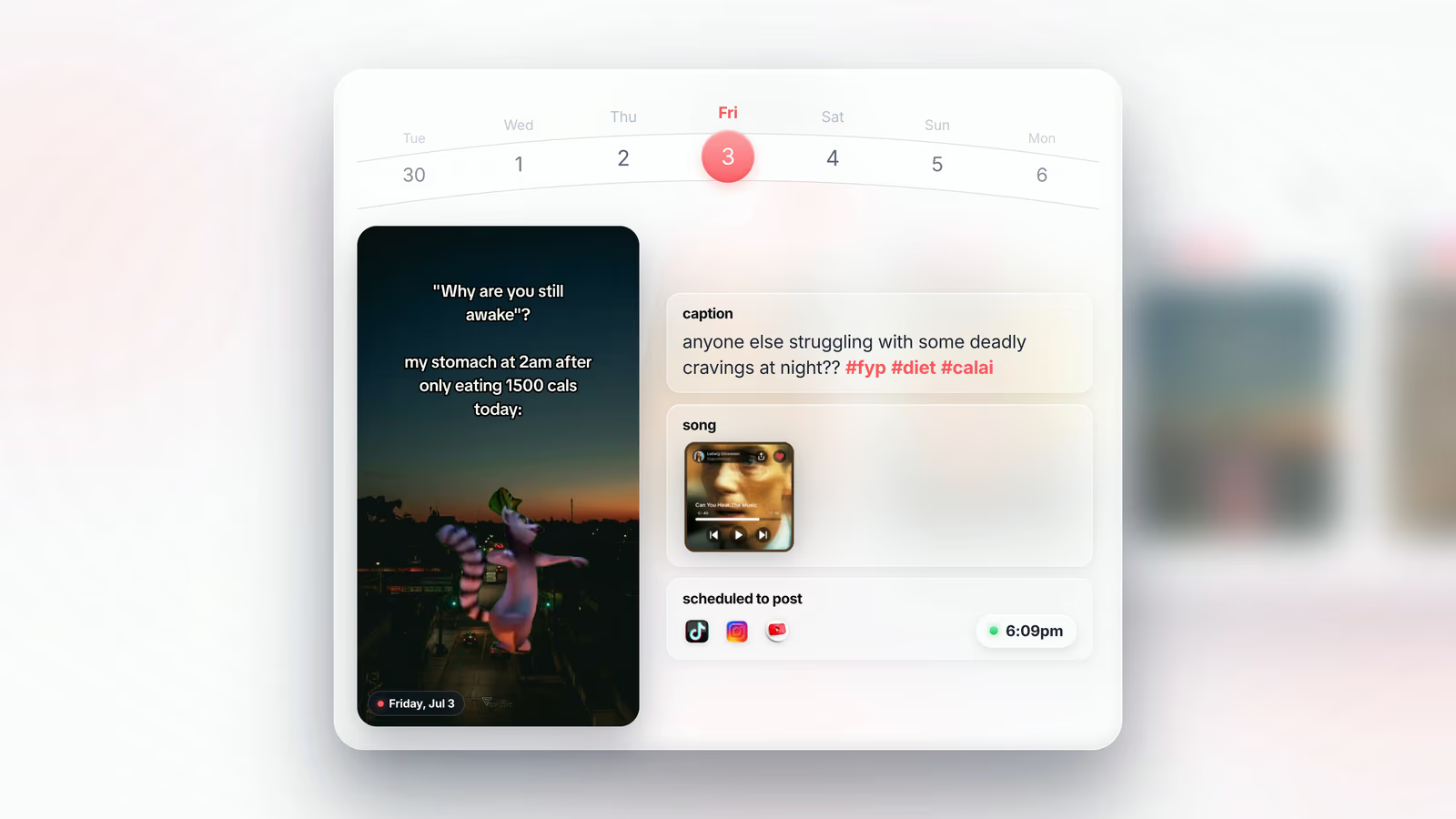
Kling 4.0 is a strong way to make a hero ad. It is not a way to run a channel. Growth on TikTok, Instagram Reels and YouTube Shorts comes from posting consistently, testing many hooks and doubling down on what converts, and that is the job Fastlane does. Generate your 30-second hero cuts in Kling 4.0, then upload them into Fastlane to schedule them weeks ahead and publish natively to TikTok, Reels and Shorts from one place. Fastlane's unified analytics attribute signups and sales to each post, so you can see whether the longer Kling 4.0 cut actually beats your 15-second versions instead of guessing from views.
Fastlane also fills the rest of the calendar without waiting on any single model. Paste your website URL and Fastlane's AI TikTok video generator turns it into a stream of short-form content: hyper-realistic AI UGC videos from a library of 1,000+ AI UGC characters, slideshows, hook + demo videos and memes, with live trend remixing so you are posting what is working this week. Blitz mode lets you swipe through generated content Tinder-style and approve the keepers in minutes. If you would rather not build accounts from zero, Fastlane offers human-warmed TikTok and Instagram accounts, and teams that want it handled end to end can use the done-for-you agency service.
Should you switch to Kling 4.0 now?
If you make hero ads, yes, test it this week: run your best-performing 15-second ad as a 30-second Kling 4.0 shot list with keyframes on the hook, the product and the end card, and compare. If you depend on an API or need fixed per-second pricing, keep Kling 3.0 in production until the Kling 4.0 API opens. Either way, the model is only half the system. The other half is getting dozens of videos a week onto TikTok, Reels and Shorts and knowing which ones drive revenue. Start free at usefastlane.ai, no credit card required, with paid plans from $29 a month, and plug your Kling 4.0 clips straight into a content engine that already knows what to post next.
Frequently asked questions
What is Kling 4.0?
Kling 4.0 is the fourth-generation AI video model from Kuaishou's Kling AI, built for single-pass clips of up to 30 seconds with keyframe and multi-reference control.
When did Kling 4.0 come out?
Kuaishou announced Kling 4.0 on 28 September 2026 with a Flash closed beta, and the full model officially launched on 15 October 2026.
How long can Kling 4.0 videos be?
A single Kling 4.0 generation runs up to 30 seconds, and Kuaishou says video extension to two minutes is on the way.
Is there a Kling 4.0 API?
Not yet: Kuaishou says API access for enterprises and developers is coming soon, so Kling 4.0 is used through the Kling web platform and app today.
Is Kling 4.0 better than Kling 3.0?
Kling 4.0 doubles clip length, adds 10 keyframes and 15 references, while Kling 3.0 remains the choice when you need a published per-second API price.
Is Kling 4.0 free?
Kling 4.0 generations cost Kling credits, and the Kling free tier has historically been watermarked and limited to non-commercial use, so plan on a paid plan for ads.
Can I post Kling 4.0 videos with Fastlane?
Yes: upload Kling 4.0 clips into Fastlane to schedule them weeks ahead and publish them natively to TikTok, Instagram Reels and YouTube Shorts, with signups and sales attributed to each post.