Vidu AI Explained: What Vidu Q4 Means for Marketers in 2026
Vidu AI is ShengShu Technology's AI video generator, and its new flagship, Vidu Q4 Preview, launched on 7 October 2026 with 4K output, native audio and up to 16 second clips. Here is what it does, what it costs, and how to use it for TikTok, Reels and Shorts.
Key takeaways
- Vidu AI is the AI video generator built by ShengShu Technology, and Vidu Q4 Preview is its next-generation flagship model, released on 7 October 2026.
- Vidu Q4 Preview generates clips of up to 16 seconds with synchronized speech and sound effects, at up to 4K resolution with 10-bit color.
- Vidu Q4 accepts up to 15 reference images and 3 voice references, but the Preview has no text-to-video mode: every clip starts from an image.
- Vidu Q4 launch pricing starts at $0.014 per second at the lowest resolution, through the Vidu web app and API.
- Vidu Q4 Preview debuted 3rd on the Artificial Analysis image-to-video leaderboard with 1,179 Elo on 8 October 2026.
Vidu AI is the AI video generator built by ShengShu Technology, and its newest flagship model, Vidu Q4 Preview, went live on 7 October 2026. Q4 takes an image, or a stack of up to 15 reference images and 3 voice clips, and returns a clip of up to 16 seconds with synchronized speech and sound effects, at up to 4K. Launch pricing starts at $0.014 per second. What makes it worth a marketer's attention is not the resolution but the acting: ShengShu built Q4 to keep a character's face, emotion, body movement and voice moving together, which is exactly what talking-head short-form needs. Here is what Vidu does, what it costs, and how it fits a TikTok, Reels and Shorts workflow.
What is Vidu AI?
Vidu AI is a generative video platform from ShengShu Technology that turns images, reference photos and audio into short videos, available as a web app and through the Vidu API. The model versions carry a Q number. Vidu Q3 Pro, announced on 30 January 2026, was the release that put Vidu on most shortlists: it generated up to 16 seconds of 1080p video with dialogue, sound effects and music in the same pass, and in April 2026 ShengShu added a reference-to-video mode for story-driven work.
Vidu Q4 is the next-generation flagship, and the version live today is a Preview. That label matters: it is the first public look at Q4, sold at launch pricing, and specs and prices may move before the full release. ShengShu has not announced a date for that full release.
What can Vidu Q4 actually do?
- Generate clips of up to 16 seconds: 3 to 16 seconds in image-to-video, 1 to 16 seconds in reference-to-video.
- Output at 540p, 720p, 1080p, 2K or 4K, with 10-bit color depth.
- Take up to 15 reference images to lock a character, product, outfit or set across a generation.
- Take up to 3 audio references of 3 to 12 seconds each, so a character can keep the same voice.
- Generate synchronized dialogue and sound effects with the picture, with automatic camera switching inside a clip.
- Run in the Vidu web product or through the Vidu API platform.
What it cannot do yet is text-to-video. The Q4 Preview supports image-to-video and reference-to-video only, which is also why it shows up on the image-to-video leaderboards and not on the text-to-video ones.
Why does acting matter more than 4K for short-form?
Most AI video launches are sold on cinematic shots: drone sweeps, rain on neon, a car chase. Short-form marketing is mostly faces. A creator talking to camera, a reaction to a product, someone holding up a box and saying one line. Those clips fail the moment the mouth, the eyebrows and the voice drift apart, because viewers read faces faster than anything else in the frame.
Q4 is the first Vidu release ShengShu frames around performance: subtler expressions, clearer emotional reads, and body movement that matches the voice. Put that next to 3 voice references and up to 15 image references, and you get the ingredients for a recurring character who looks and sounds the same on Monday and on Friday. That consistency is the whole game in AI UGC.
For short-form, a model that can act beats a model that can light a scene, because the feed is mostly faces.
The 4K output, by contrast, is mostly a spec sheet win for social. TikTok, Reels and Shorts compress hard, and 1080p vertical is plenty for a phone screen. Save 4K for ads you will also run on large screens.
How much does Vidu Q4 cost?
Launch pricing for Vidu Q4 Preview starts at $0.014 per second (RMB 0.09), and ShengShu says that buys up to five times more output for the same budget than earlier versions at comparable settings. Read the fine print: that floor applies at the lowest resolution. Artificial Analysis measured Q4 at about $7.20 per minute at production-quality settings, so a 16 second 1080p clip costs meaningfully more than the headline rate suggests. The practical move is to prototype hooks at 540p or 720p, where clips are cheap, and only re-render the winners at 1080p.
How good is Vidu Q4 compared to other AI video models?
Vidu Q4 Preview debuted 3rd on the Artificial Analysis image-to-video leaderboard on 8 October 2026, with an Elo of 1,179 from more than 5,000 votes. That puts it in the top tier on day one, just behind the two leaders on that board. It does not appear on the text-to-video board at all, because it has no text-to-video mode.
In practice, the field this autumn looks like this. Seedance 2.5 and Kling 3.0 remain the picks for raw cinematic quality, MiniMax H3 is the open-weights option with native audio, Veo 3.1 is Google's multi-reference workhorse, and Gemini Omni is the conversational editor. Each has a reference page in our models hub, and Vidu Q4 now has one too. Vidu's lane is character performance from references. No single model wins every shot, so keep your generation step swappable and pick per job.
How should marketers use Vidu Q4 for TikTok, Reels and Shorts?
- Start from an approved character image and product shots, since every Q4 generation needs at least one image.
- Record or pick one voice and reuse it as an audio reference, so a recurring character sounds the same across a series.
- Generate the first 2 to 3 seconds as separate hook variants; the hook decides whether anyone sees the rest.
- Prototype at 540p or 720p, then re-render only the clips that test well at 1080p.
- Stitch 16 second shots into 20 to 45 second posts, add captions, and keep the product visible early.
- Disclose AI-generated content on TikTok and Instagram rather than hoping nobody checks.
The bigger lesson from every model launch this year is that generation keeps getting cheaper and better, while the rest of the job stays exactly as hard. Someone still has to decide what to post, approve it, schedule it across three platforms, and figure out which clip actually drove a signup.
Where does Fastlane fit with Vidu AI?
Fastlane is the layer after the model. If you make character-led hero clips in Vidu Q4, upload them into Fastlane, schedule them weeks ahead, and publish natively to TikTok, Instagram Reels and YouTube Shorts from one place, with unified analytics that attribute signups and sales to each post. That is how you find out whether the 4K render was worth it.
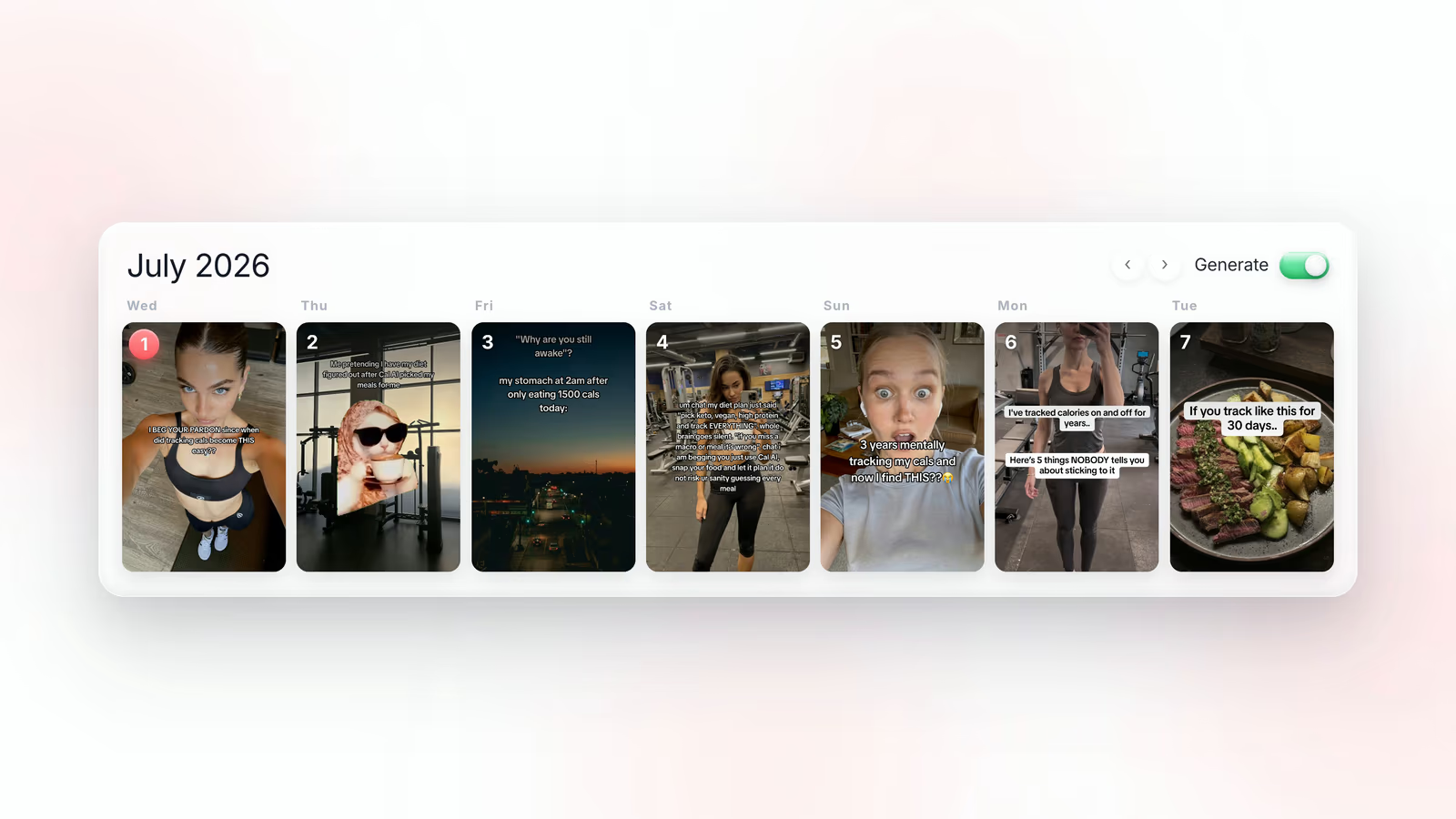
For everything else, Fastlane generates content straight from your website URL without depending on any one model. Fastlane's AI UGC video generator draws on a library of 1,000+ hyper-realistic AI UGC characters, and you also get slideshows, hook plus demo videos, memes and live trend remixes. Blitz mode lets you swipe through a week of generated content Tinder-style in minutes, and teams that want to drive it from their own stack can use the developer API and MCP. More than 50,000 users already run their short-form this way.
Vidu Q4 is a real step toward AI characters that can carry a line, and another model will top a leaderboard before the quarter is out. The model is not the bottleneck; the pipeline is. Start free with no credit card at usefastlane.ai, with paid plans from $29 a month.
Frequently asked questions
What is Vidu AI?
Vidu AI is an AI video generator from ShengShu Technology that turns images, reference photos and voice clips into short videos with native sound, available on the web and through an API.
When was Vidu Q4 released?
ShengShu released Vidu Q4 Preview on 7 October 2026 and has not yet announced a date for the full Q4 release.
Is Vidu Q4 free?
Vidu Q4 is a paid model, with launch pricing that starts at $0.014 per second at the lowest resolution and rises at higher resolutions.
Can Vidu Q4 make videos from text only?
No, the Q4 Preview supports image-to-video and reference-to-video only, so you need at least one image to start a generation.
What changed from Vidu Q3 to Vidu Q4?
Vidu Q3 Pro, announced on 30 January 2026, made 16 second 1080p clips with native audio, and Q4 Preview adds 2K and 4K output, 10-bit color, up to 15 image and 3 voice references, and more expressive acting.
Is Vidu Q4 good for TikTok and Reels?
Vidu Q4 suits character-led short-form clips such as talking-head and reaction shots, though 16 seconds per generation means longer videos still need stitching and captions.
Can I use Vidu clips with Fastlane?
Yes: upload Vidu clips into Fastlane to schedule them weeks ahead and publish them natively to TikTok, Instagram Reels and YouTube Shorts, with signups and sales attributed to each post.