How to Automate TikTok Posting With AI (2026 Guide)
Automating TikTok posting with AI means running one pipeline that generates the video, holds it for approval, and publishes it through TikTok's official Content Posting API. Here is what each stage does, what it costs to build yourself, and where the account-safety line actually sits.
Key takeaways
- Automating TikTok posting with AI means running a four-stage pipeline: research the niche, generate the script and video, pass a human approval gate, then publish through TikTok's official Content Posting API.
- An AI TikTok stack has five layers in 2026: research, generation, orchestration, publishing, and the all-in-one products that replace the other four with one subscription.
- A self-built pipeline needs six or seven separate services running at once: an LLM for scripts, a text-to-speech voice, a video model, a renderer, object storage, a scheduler, and a maintained TikTok API integration whose tokens expire.
- TikTok's Content Posting API is the only sanctioned route to scheduled publishing, so emulators and headless browsers are what get accounts restricted, not the fact that a video was made with AI.
- Fastlane covers all five layers from one website URL, publishes natively to TikTok, Instagram Reels and YouTube Shorts, and starts on a free plan with paid plans from $29 per month.
To automate TikTok posting with AI, you connect four stages into one pipeline: something decides what to post, something generates the video, a human approves it, and something publishes it to TikTok through the platform's official API at a scheduled time. Every working setup in 2026 is some version of that chain. The interesting question is not whether it can be done, because it plainly can, but which parts you assemble yourself and which parts you let a single product handle. This guide walks the pipeline stage by stage, shows what the do-it-yourself version really costs, and marks the one line you cannot cross without risking the account.
What does it mean to automate TikTok posting with AI?
Automating TikTok posting with AI is the practice of using software to generate short-form video content and publish it to TikTok on a schedule, without a person filming, editing or uploading each individual post by hand. The phrase covers two jobs that are often confused. The first is content automation: an AI model writes the hook, the script and the caption, and produces or assembles the visuals. The second is publishing automation: a system holds the finished file and sends it to TikTok at a chosen time through TikTok's Content Posting API. A tool can do one of these without the other, and most tools do exactly one, which is why so many people end up gluing two subscriptions together.
The reason the combination matters is that neither half is useful alone. A generator that cannot publish leaves you downloading files and uploading them by hand every morning, which is the exact chore you were trying to remove. A scheduler that cannot generate leaves you back at the blank page, which was the harder problem in the first place. The value shows up when one system carries an idea all the way from a topic to a live post with your approval in the middle.
What are the four stages of an AI TikTok pipeline?
Whether the pipeline is a no-code workflow, a custom backend or a single product, it always breaks into the same four stages:
- Research. Pull what is currently working in your niche, from trending formats and sounds to the hooks your competitors are getting watched on, so the generator has something better than a cold prompt to work from.
- Generate. Turn the brief into a hook, a 15 to 45 second script, a caption and hashtags, then produce the media: an AI presenter, a slideshow, a screen demo, stock or generated B-roll, a voiceover and burned-in captions, exported vertical at 1080x1920.
- Approve. Put a human in front of the queue to kill the duds, fix a caption typo and confirm the claim in the script is one you can stand behind.
- Publish. Send the approved file to TikTok through the Content Posting API at the scheduled time, with the caption, the privacy setting and the AI-generated content label attached.
Stages one and two are where most of the tooling noise lives, because generation is the visible, demoable part. Stages three and four are where accounts are won and lost.
Why does the publishing step decide whether the whole thing is safe?
TikTok offers an official Content Posting API. An approved developer application can upload a video directly to a connected account or drop it into that account's drafts for review in the app. Publishing this way is sanctioned, it is what legitimate scheduling tools use, and it carries the account's own authorisation rather than pretending to be a person tapping a screen.
What gets accounts restricted is the other route: scripts driving the TikTok app in an emulator, headless browsers logging in and clicking upload, fleets of accounts created in bulk and run unattended from one machine. TikTok's policies target inauthentic and automated operation of accounts, not the fact that a video was made with AI. Read that sentence twice, because it inverts the fear most people bring to this topic. The AI is not the risk. The unsanctioned publishing method is the risk.
Publishing through the official API is allowed. Automating the app itself is not. Almost every ban story you read is a story about the second thing.
Should you build the pipeline or buy a platform?
There are three honest routes, and they suit different people. The no-code route chains an automation platform such as n8n or Make to a content database and a publishing integration, and suits someone who enjoys wiring things together and wants control over each step. The custom backend route is a cron job calling an LLM, a text-to-speech service, an image or video model, a rendering step and the TikTok API, and suits a team with a developer and a specific requirement no product meets. The platform route is one product that owns all four stages, and suits everybody else, which in practice is most founders and most small marketing teams.
What does the do-it-yourself stack actually cost you?
The honest cost of building it yourself is rarely the monthly bill. It is the number of separate things that can break. A working self-built pipeline needs an LLM subscription for scripts, a text-to-speech voice, an image or video model, a renderer to assemble and caption the output, object storage to hold the files, a scheduler to fire on time, and a maintained TikTok API integration with tokens that expire and scopes that change. That is six or seven services, each with its own pricing page, its own outage and its own breaking change.
The failure mode is predictable and boring. The pipeline works beautifully for three weeks, then a model version changes its output format, or an access token silently expires, and nothing posts for four days before anybody notices. Short-form distribution rewards consistency more than almost anything else, so four silent days is a real cost, not a hypothetical one. Weigh that against a single subscription before deciding the build is cheaper.
Which tools sit in each layer of an AI TikTok stack?
An AI TikTok stack is the set of tools that carry a post from an idea to a live video, and in 2026 it separates cleanly into five layers. Most published guides list tools without saying which layer each one belongs to, which is why so many people buy two products that do the same job and none that does the missing one. Sorted by layer, the market looks like this:
- Research layer. Trend and competitor tools, or a spreadsheet you fill in by hand, that tell the generator which formats, sounds and hooks are currently being watched in your niche.
- Generation layer. Products that turn a brief, a script or a product URL into a finished vertical file. AI UGC and avatar generators, slideshow builders, faceless-video generators and long-to-short clippers all live here.
- Orchestration layer. Automation platforms such as n8n, Make and Zapier that move files and metadata between the other layers whenever a trigger fires.
- Publishing layer. Schedulers and upload bridges holding TikTok API access, which store the finished file and post it at a set time with the caption, privacy setting and AI-generated content label attached.
- All-in-one layer. One product that covers the four above, so there is a single subscription, a single login and a single place the pipeline can break. Fastlane sits in this layer: it researches, generates, holds the queue for approval and publishes natively.
The layer view also explains the most common failure. A generator bought without a publishing layer leaves you downloading files every morning. A scheduler bought without a generation layer leaves you at the blank page. Buy across layers, or buy one product that spans them.
How much does automating TikTok posting cost in 2026?
Cost splits the same way the stack does. A self-built pipeline pays for six or seven services at once and adds engineering hours every time a model output format or an API scope changes. An all-in-one platform is one bill. Fastlane starts on a free plan with no credit card, and paid plans begin at $29 per month. If the constraint is somewhere to post from rather than something to post, human-warmed TikTok and Instagram accounts, created from scratch by real people in up to 12 countries and warmed for five days in your niche, are $100 per account per month with uploads at $1.50 per post. Price the routes against each other before assuming the build is cheaper, because the build's real cost is the four silent days after a token expires.
Do you have to disclose AI-generated TikTok videos?
Yes. TikTok requires that realistic AI-generated content be disclosed, and it provides a label for exactly this. Its publishing API includes a flag for AI-generated content, which means a well-built pipeline can set the disclosure automatically on every upload rather than relying on somebody remembering. Treat that flag as part of the publishing payload, not as an optional extra, and the compliance question stops being a question. Undisclosed synthetic content is one of the few things in this space that will reliably get a video pulled.
How many videos should an automated account post?
Automation makes it trivially easy to post twenty times a day, and that is usually a mistake. The feed rates each video on how long people watch it, so twenty weak posts train the system on twenty weak signals. One to three genuinely reviewed posts a day, held to a consistent format and a niche the account actually owns, outperforms high-volume spraying in almost every case. The right use of automation is not more posts, it is the same number of good posts without the daily production grind, plus enough spare capacity to run several formats against each other and find out which one your audience responds to.
Where should the human stay in the loop?
Keep the human at the approval gate, and nowhere else. Ideation, scripting, rendering, captioning, scheduling and uploading are all better done by software, because they are repetitive and the machine does not get bored on day forty. Judgement is the part that does not automate: is this hook actually good, is this claim about the product true, does this joke land in this niche. A pipeline that generates a week of content in an afternoon and asks you to spend ten minutes approving it has put the human exactly where the human adds value.
How Fastlane automates the whole pipeline
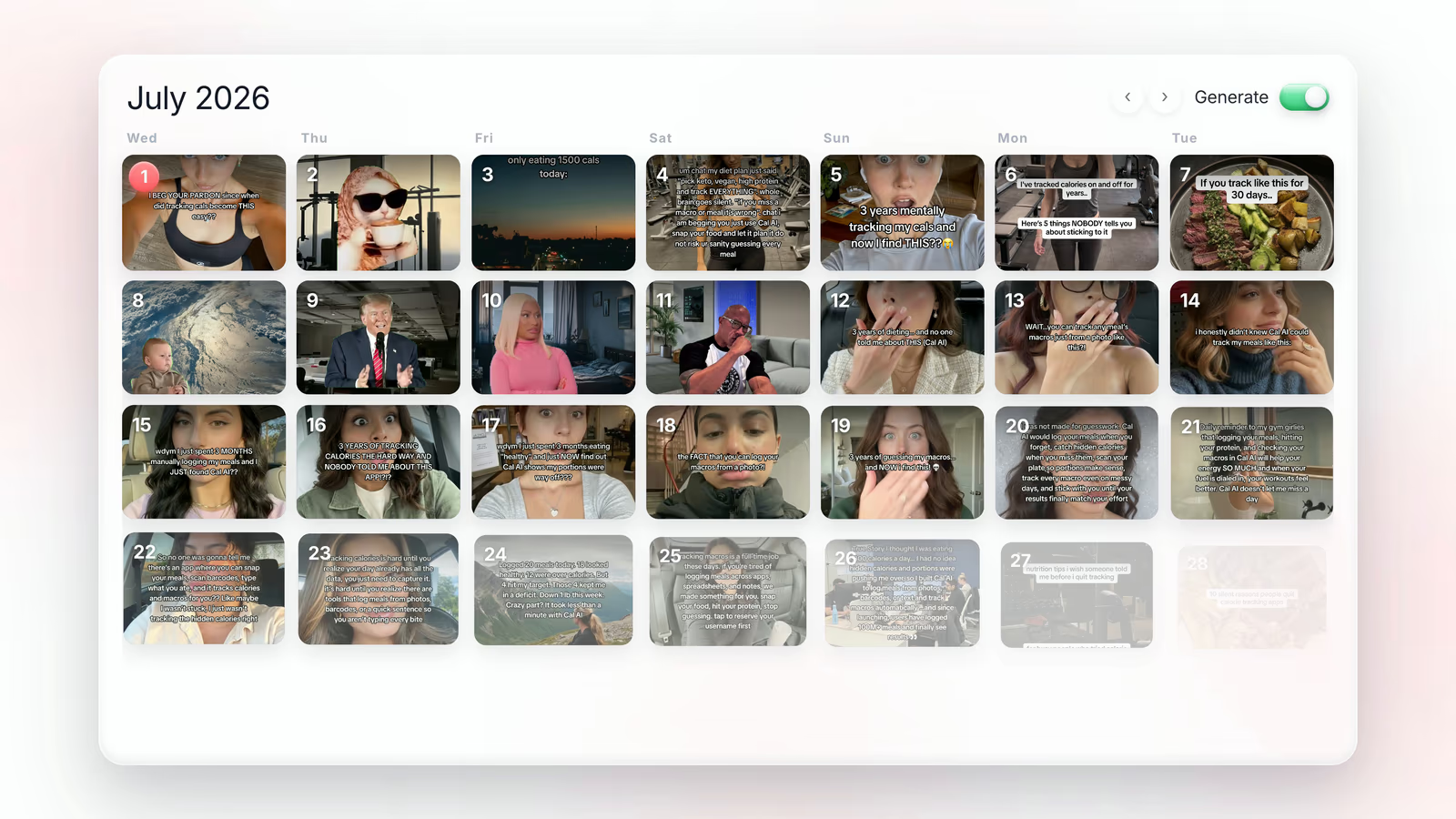
Fastlane is an AI platform that runs all four stages from a single input: your website URL. It reads your site to learn the product, the positioning and the audience, then generates short-form content in several formats, including hyper-realistic AI UGC videos drawn from a library of more than 1,000 AI characters, slideshows, hook and demo videos and memes. Live trend remixing keeps the formats current rather than frozen at whatever was working when you signed up.
Approval happens in Blitz mode, a Tinder-style swipe through everything that was generated: swipe right to keep, left to bin. Approved content schedules weeks ahead and publishes natively to TikTok, Instagram Reels and YouTube Shorts, so the same pipeline feeds all three feeds instead of only the one you set up. Unified analytics then attribute signups and sales back to individual posts, which turns the whole thing from a content treadmill into something you can actually judge. For teams that want the pipeline inside their own stack, there is a developer API and an MCP server, so an agent in Claude or Cursor can generate, schedule and publish on its own.
If the fleet of accounts is the bottleneck rather than the content, Fastlane also supplies TikTok and Instagram accounts created from scratch by real humans in up to 12 countries and warmed for five days in your niche, at a $100 per account per month launch offer. There is a free plan with no credit card required, and paid plans start at $29 per month. Start at usefastlane.ai, paste your URL, and see a week of posts before you decide whether the pipeline is worth building yourself.
Frequently asked questions
Can you fully automate TikTok posting?
You can automate generation, scheduling and publishing end to end, but the accounts that survive keep one human approval step between generation and publishing.
Is automating TikTok posting against TikTok's rules?
No, publishing through the official Content Posting API is sanctioned; what breaks the rules is driving the app with emulators, browser bots or bulk unattended accounts.
Do you need coding skills to automate TikTok posting?
Not any more: a no-code route chains a scheduler to an automation platform, and a platform route does the whole pipeline in one product, while only the custom backend route needs a developer.
Do you have to disclose AI-generated TikTok videos?
Yes, TikTok requires realistic AI-generated content to be labelled, and its publishing API carries a flag for exactly that purpose.
How many videos a day should an automated TikTok account post?
One to three well-reviewed posts a day beats ten unreviewed ones, because the feed rates each video on watch time rather than rewarding raw upload volume.
What tools do you need to automate TikTok posting with AI?
You need one tool per layer: research, generation, orchestration and publishing, or a single all-in-one product such as Fastlane that covers all four from a website URL.
How much does it cost to automate TikTok posting with AI?
A self-built stack runs six or seven subscriptions at once, while an all-in-one platform is one bill: Fastlane starts free with no credit card and paid plans begin at $29 per month.
How does Fastlane automate TikTok posting?
Fastlane reads your website URL, generates AI UGC videos, slideshows, hook and demo videos and memes from it, lets you approve them in Blitz mode, and publishes them natively on the schedule you set.
Can one automated pipeline post to Instagram and YouTube as well?
Yes, and it should: Fastlane publishes the same generated content natively to TikTok, Instagram Reels and YouTube Shorts, and attributes signups and sales back to individual posts.