
The YouTube Shorts Algorithm in 2026: What Works Now
The YouTube Shorts algorithm in 2026 ranks on swipe-away rate, completion, and rewatches, and it now runs completely separately from long-form. Here is how it works and how to grow on Shorts.
Key takeaways
- Swipe-away rate is the dominant YouTube Shorts ranking signal in 2026, and a swipe-through rate under roughly 30 percent stops a Short from being distributed further.
- YouTube separated the Shorts recommendation system from long-form in late 2025, so Shorts performance no longer drags down or lifts a channel's long-form reach.
- Shorts in the 22 to 45 second band tend to outperform both shorter and longer clips, with retention thresholds around 65 percent under 30 seconds and 50 percent for 30 to 60 second Shorts.
- YouTube detects platform watermarks, so a TikTok export uploaded to Shorts with the watermark still on it gets demoted before anyone watches it.
- AI generated Shorts are allowed and monetizable when they add real creative value, but the inauthentic content policy (renamed from repetitious content on July 15, 2025) penalizes mass-produced recycled uploads.
The YouTube Shorts algorithm in 2026 comes down to one question asked millions of times a second: did this viewer keep watching, or did they swipe? Everything else is downstream of that. Over the past year YouTube separated the Shorts recommendation engine from long-form entirely, made swipe-away rate the dominant ranking input, got much better at telling a genuine rewatch apart from a padded loop, and tightened the rules on reposted and mass-produced uploads. If your Shorts views fell off a cliff without any obvious change on your end, one of those shifts is almost certainly the cause. Here is how the system actually works now, and what to do about it.
What is the YouTube Shorts algorithm?
The YouTube Shorts algorithm is the recommendation system that decides which vertical videos under three minutes get shown in the Shorts feed, and to whom. It is not a search engine and it is not the same model that powers the YouTube homepage for long-form video. It is a pull-based feed system: instead of surfacing videos to people who already subscribed to you, it tests every upload against a small sample of viewers it thinks might like it, then decides whether to widen that audience based on how those viewers behaved.
That design is why a channel with 40 subscribers can post a Short that reaches 300,000 people, and why a channel with 400,000 subscribers can post one that reaches 2,000. Subscriber count is close to irrelevant as a ranking input. What matters is the behavior of the viewers in each test batch.
How does the YouTube Shorts algorithm work in 2026?
In practice, distribution runs in roughly three stages:
- Seed test: your Short goes out to a small audience sample, and the system watches the first few seconds closely to see how many people swipe away immediately.
- Velocity escalation: if swipe-through and completion rates clear the bar, the Short is released to progressively larger audiences, and each new batch has to clear the bar again.
- Cross-surface amplification: the best performers get planted beyond the Shorts feed, appearing on the home feed and next to related long-form watch pages.
The important consequence is that a Short does not have one shot at going viral. It has many sequential shots, and it can stall at any stage. This is also why Shorts often pick up days or weeks after posting: a clip that held retention in a small batch can be re-tested later against a bigger audience.
Why swipe-away rate decides how far your Short travels
Swipe-away rate is the percentage of viewers who scroll past your Short rather than watching it, and it is the closest thing the 2026 system has to a master signal. Flipped around, swipe-through rate above roughly 50 percent is strong, and below roughly 30 percent effectively ends distribution before the Short reaches anyone new. No amount of good editing later in the clip compensates for a weak opening, because most of the audience that would have judged it never got there.
What this means for how you make content is blunt. The first frame and the first spoken or on-screen line are the product. A clear visual, a specific promise, and a reason to stay within the first second matter more than production quality across the rest of the video. The practical winning move is not to perfect one hook, it is to test many hooks cheaply and let the feed tell you which one holds people.
Do Shorts affect your long-form videos?
No, and this is one of the biggest changes creators still have not internalized. YouTube fully separated the Shorts recommendation engine from long-form in late 2025. Shorts are now evaluated on their own terms: a run of weak Shorts will not suppress your long-form reach, and a Short with 2 million views will not automatically push viewers into your long-form catalogue either. The upside is that Shorts are now a free swing. A brand can post Shorts aggressively without worrying about poisoning a main channel, which removes the single biggest reason companies used to hold back.
What is the best length for a YouTube Short?
Retention percentage, not raw seconds watched, is what the system scores. Reported thresholds sit around 65 percent average view duration for Shorts under 30 seconds and around 50 percent for Shorts in the 30 to 60 second range. Because a longer clip has to hold a lower share of a longer runtime, the two constraints meet in the middle: the 22 to 45 second band consistently beats both extremes for most niches. Explainer content skews toward the upper end at 35 to 45 seconds, while curiosity or hook-driven content does better at 22 to 30 seconds.
A 20 second Short that most people finish will out-travel a 60 second Short that most people abandon at second eight.
Do loops and rewatches still boost Shorts?
Rewatches remain a powerful signal, because Shorts loop by default and repeat views compound total watch time. What changed in 2026 is that YouTube got better at telling the difference between a natural rewatch, where a viewer chose to see something again, and a systemic loop, where a clip was engineered so the video simply replays past an unresolved ending. Deliberately cutting a Short so it loops forever is no longer the cheat code it was in 2023. Earning a real second watch, with a detail worth catching or a punchline that lands differently the second time, still works.
Which engagement signals matter most now?
Once retention clears the bar, the secondary signals sort winners from the merely acceptable. In rough order of weight:
- Swipe-through and average view duration, which gate everything else.
- Shares, which act as an active recommendation and are the strongest secondary signal.
- Rewatches and saves to playlists, both of which read as strong intent.
- Subscribe rate driven by a specific Short, which tells YouTube the clip converted a stranger.
- Comments and likes, which still help but move distribution far less than the signals above.
- Trending or sampled audio, which can place your Short on that sound's page and unlock an extra distribution surface.
Does reposting TikToks to Shorts hurt your reach?
Yes. YouTube runs watermark detection and content hashing on uploads, and a Short carrying a visible TikTok watermark is flagged as content that is not original to the platform. Even when it is your own video, the watermark makes it read as reused. On top of the reach penalty, YouTube renamed its repetitious content policy to inauthentic content on July 15, 2025 and paired it with stronger detection, so channels built on recycled or mass-produced uploads risk limited ad earnings, monetization suspension, and eventually removal from the YouTube Partner Program.
The fix is simple and non-negotiable: publish clean, watermark-free video natively to YouTube. If you are running the same asset across TikTok, Instagram Reels, and Shorts, export the source file rather than downloading your own post back off another app.
Are AI generated Shorts allowed on YouTube?
Yes. YouTube has been explicit that it treats AI as a creative tool rather than a category to ban, and AI assisted Shorts remain fully monetizable. The line it draws is between AI that adds something and AI that replaces creative effort with volume: templated, near-identical uploads pumped out at scale fall under the inauthentic content policy no matter how many views they get. Use the altered or synthetic content disclosure where the content could be mistaken for real events, keep each video genuinely distinct, and AI generation is an advantage rather than a liability.
How to grow on YouTube Shorts in 2026
Pulling it together, the playbook that works under the current system looks like this:
- Treat the first second as the whole product and test many hook variations instead of polishing one.
- Target 22 to 45 seconds and cut anything that does not defend the retention curve.
- Give people a reason to share, save, or rewatch, since those are the signals that widen distribution.
- Post natively and watermark-free, and never upload another platform's export.
- Post consistently, because every upload is an independent test and volume buys you more tests.
- Keep each Short genuinely distinct so you stay clear of the inauthentic content policy.
- Track which specific Shorts produced subscribers, signups, and sales, then make more of those.
How Fastlane helps you win the Shorts algorithm
Every requirement above points at the same bottleneck: producing enough original, hook-first vertical video, consistently, and posting it natively. That is exactly what Fastlane does. You paste your website URL, Fastlane learns your product, and it generates hyper-realistic AI UGC videos from a library of over 1,000 AI UGC characters, plus slideshows, hook and demo clips, and memes, all built around the opening second that decides your swipe-away rate. Because it remixes live trends, what you post is shaped by what is holding attention on the platform right now rather than what worked last quarter.
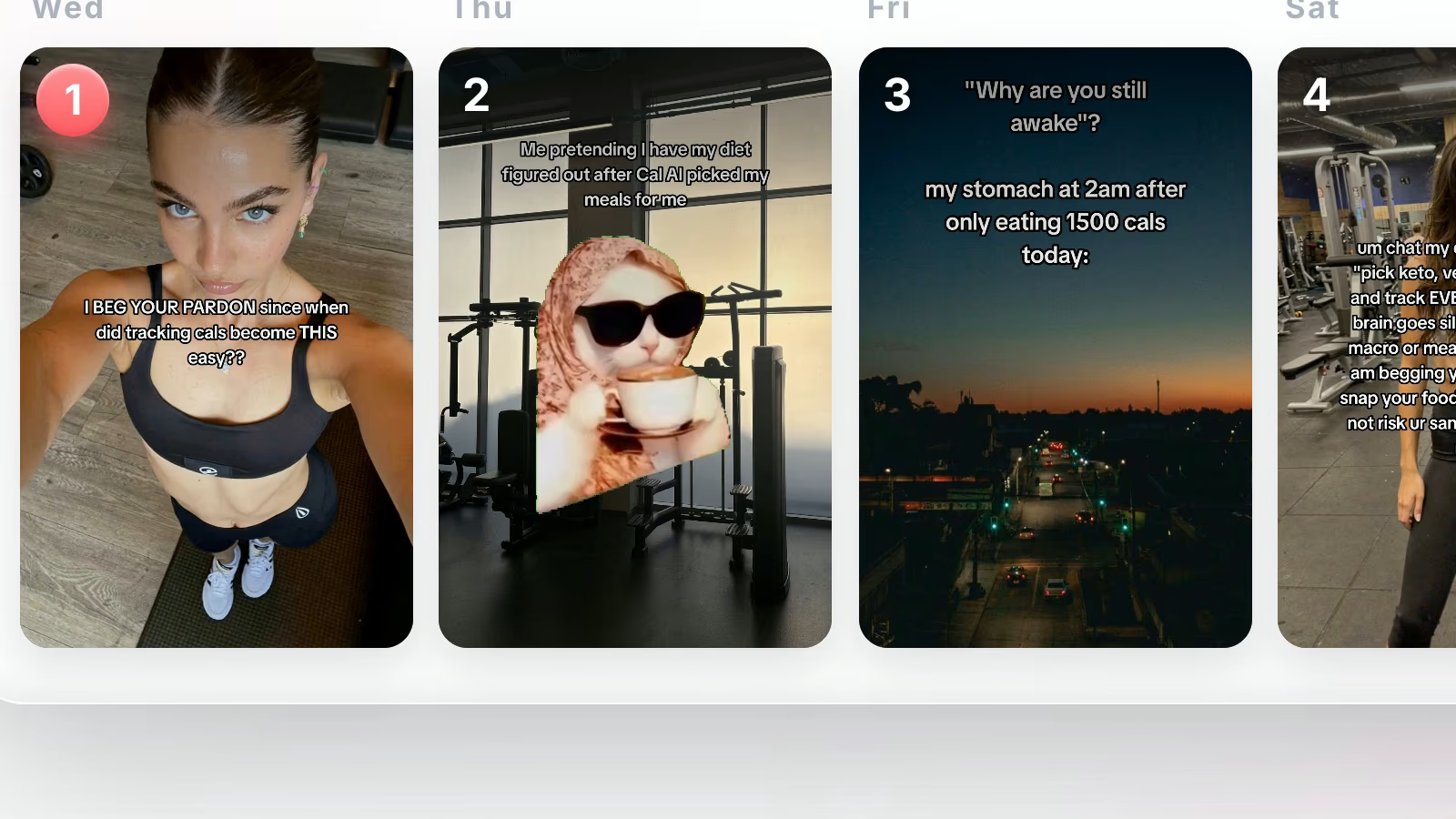
Fastlane then publishes natively to YouTube Shorts, TikTok, and Instagram Reels with no cross-platform watermark, so nothing you post trips the reused content penalty. You can schedule weeks ahead, swipe through a month of generated content Tinder-style in Blitz mode to approve what fits your brand, and read unified analytics that attribute signups and sales back to individual posts, which is how you find out which hooks actually convert instead of which ones merely got views. More than 50,000 people use it, there is a free plan with no credit card, and paid plans start at 29 US dollars per month.
The 2026 Shorts algorithm rewards brands that can ship original, finishable, shareable vertical video at volume, and it no longer cares how big your channel is. Drop your URL into Fastlane at usefastlane.ai and have a month of native, hook-first Shorts scheduled in minutes.
Frequently asked questions
How does the YouTube Shorts algorithm work in 2026?
It seeds every Short to a small test audience, measures how many viewers keep watching instead of swiping away, then escalates the Short to progressively wider audiences when swipe-through, completion, rewatch, and share rates hold up.
What is swipe-away rate on YouTube Shorts?
Swipe-away rate is the share of viewers who scroll to the next Short instead of watching yours, and it is the single most important signal in the 2026 Shorts ranking system.
Do Shorts hurt your long-form YouTube channel?
No. YouTube fully separated the Shorts and long-form recommendation systems in late 2025, so weak Shorts no longer suppress long-form reach and viral Shorts no longer automatically feed long-form views.
What is the best length for a YouTube Short in 2026?
Roughly 22 to 45 seconds performs best for most niches, because that band is long enough to deliver a payoff and short enough that a large share of viewers finish it.
Does reposting TikToks to YouTube Shorts still work?
Not well. YouTube detects other platforms' watermarks and treats visibly reposted uploads as reused content, which caps distribution and can put monetization at risk.
Are AI generated Shorts allowed on YouTube?
Yes. YouTube treats AI as a legitimate creative tool and only penalizes mass-produced, repetitive, or deceptive uploads, and creators should use the altered or synthetic content disclosure where it applies.
How does Fastlane help with YouTube Shorts?
Fastlane turns your website URL into original hook-first AI UGC videos, slideshows, and demo clips, publishes them natively to YouTube Shorts alongside TikTok and Instagram Reels with no cross-platform watermark, and reports which Shorts drove signups and sales.