Multiple TikTok and Instagram Accounts for UGC Creators
UGC creators can keep six TikTok accounts and five Instagram accounts signed in on one phone, but stacking client accounts on your personal device starts every one of them cold and in the wrong niche. Here is how to run an account per client without buying more phones.
Key takeaways
- TikTok allows six accounts signed in per device in 2026 and Instagram allows five, each needing its own email and phone number.
- Those are login caps, not distribution promises: accounts beyond the first two or three on one handset consistently see less reach.
- A client account born on your personal phone starts cold, in your niche rather than the client's, and often in the wrong country.
- Buying a phone, SIM, and email per client turns a content business into a hardware fleet, and the device still has no genuine history.
- Fastlane warmed accounts give each client its own account, built by real humans in up to 12 countries and warmed 5 days in that client's niche.
If you are a UGC creator picking up contracts on SideShift, Billo, Insense, JoinBrands, or Trend.io, you will eventually run into a wall that has nothing to do with your content. TikTok lets you keep six accounts signed in on one device in 2026, up from three, and Instagram caps you at five simultaneous logins per app. Those ceilings arrive faster than you expect once you are running an account per client, and the ceiling is not even the real problem. The real problem is that every client account born on your personal phone starts cold, in the wrong niche, and often in the wrong country. You do not fix that by buying more phones.
How many TikTok and Instagram accounts can you have on one device?
- TikTok: up to six accounts signed in on a single device as of 2026, raised from the long-standing limit of three.
- TikTok also requires a unique email address and phone number per account, so six accounts means six sets of credentials.
- Instagram: five accounts signed in at the same time per app, and a sixth returns an error until you log one out.
- Instagram does not cap how many accounts you can own overall, only how many stay signed in on one device at once.
Read those numbers carefully, because they are login caps and nothing more. Six slots is a statement about what the app will let you sign into. It is not a promise that six accounts on one handset will all get distribution, and in practice they will not.
Why does this hit UGC creators harder than anyone else?
Because your business model is one account per client, and the number of clients is supposed to go up. Say you built @emily.nutrition into a genuine nutrition page and it is why brands hire you in the first place. Then you sign a contract to run a page for Nike. Then Venmo. A nutrition audience, a sportswear audience, and a fintech audience have nothing to do with each other, so you cannot post all three from the account you already have without wrecking it. You need a separate account per brand, which is exactly the thing your phone will not give you more than a handful of.
The marketplaces have made this worse simply by making contracts easier to win. SideShift, a Gen Z focused marketplace connecting brands with short-form creators, states on its own site that it has onboarded more than 700,000 creators and paid out over $100M. Insense, JoinBrands, Billo, and Trend.io are all pushing volume through the same funnel. Landing your fourth and fifth brand is more achievable than it has ever been. Running your fourth and fifth account is not.
What actually goes wrong when you stack client accounts on one phone?
- You hit the hard login cap, then start cycling logins in and out, which is friction at best and an unusual pattern at worst.
- Every new account starts from absolute zero: no watch history, no follows, no engagement, nothing the algorithm can use to place your first post.
- The device and network the account is born on have a history pointed entirely at your existing niche, which is the wrong starting hypothesis for a fintech or sportswear page.
- Your location is your location, so a US client campaign run from Sydney or Manila skews local in exactly the early window that matters most.
- The account is tangled up with your personal login, which makes a clean handover at the end of the contract awkward.
Does posting from one device actually get you shadowbanned?
Here is the honest version, because there is a lot of confident nonsense written about this. Shadowban is not an official product on either platform, and neither TikTok nor Instagram publishes a device threshold at which your reach gets cut. What is documented is that both cap simultaneous logins per device, and that platforms use a broad range of signals, including device and network, to detect spam and coordinated behaviour. What sits on top of that is a pattern creators report consistently: past the first two or three accounts on a single handset, at least one of them tends to underperform in a way that is hard to explain by content quality alone.
Treat that as a reliable pattern rather than a published rule. The practical takeaway is the same either way: do not build a client roster on the assumption that you can stack ten accounts on one phone and have them all work.
Why niche mismatch quietly kills a new client account
Recommendation systems have to guess who a new account is for, and they make that guess early, from whatever signals exist. A brand new Venmo page created on the phone of an established nutrition creator, following nutrition accounts, on a connection that has only ever engaged with food and fitness content, hands the algorithm a starting hypothesis that is completely wrong. The first few videos then get tested against an audience that has no reason to care about them. Those first videos are the most valuable ones you will ever post on that account, and you have spent them proving to the platform that nobody wants the content.
A new client account does not fail because your content is bad. It fails because the platform decided who it was for before you posted anything.
Do you need to buy a second phone?
No, and the standard second-phone advice is a bad trade for a creator. A handset is real money up front, and it needs its own SIM, its own number, and its own email before it is useful. Then it needs weeks of genuine use before the account on it looks like anything other than a brand new account on a brand new device, which is the exact problem you were trying to solve. Multiply that by every contract you win and you are running a hardware fleet instead of a content business.
The other route people reach for, emulators, antidetect setups, and phone farms, is a worse deal for a UGC creator specifically. Mobile-first platforms are good at spotting devices that are not real devices, the tooling is built for desktop-scale operations rather than someone servicing five brands, and if it goes wrong your own established account is in the blast radius. Your personal page is your portfolio. It is the asset that wins you contracts. It is not worth risking to save a setup fee.
What about location targeting?
This is the part creators outside the US underrate. A large share of UGC contracts are for American brands chasing an American audience, and early distribution leans heavily on where the account actually is. If you are posting from Manila, Sydney, or London for a US client, the first wave of viewers is disproportionately local, the engagement signals that come back are from the wrong market, and the account learns the wrong audience. You can produce a genuinely great video and still report weak numbers to the client because the video went to the wrong country.
How warmed accounts solve the multi-client problem
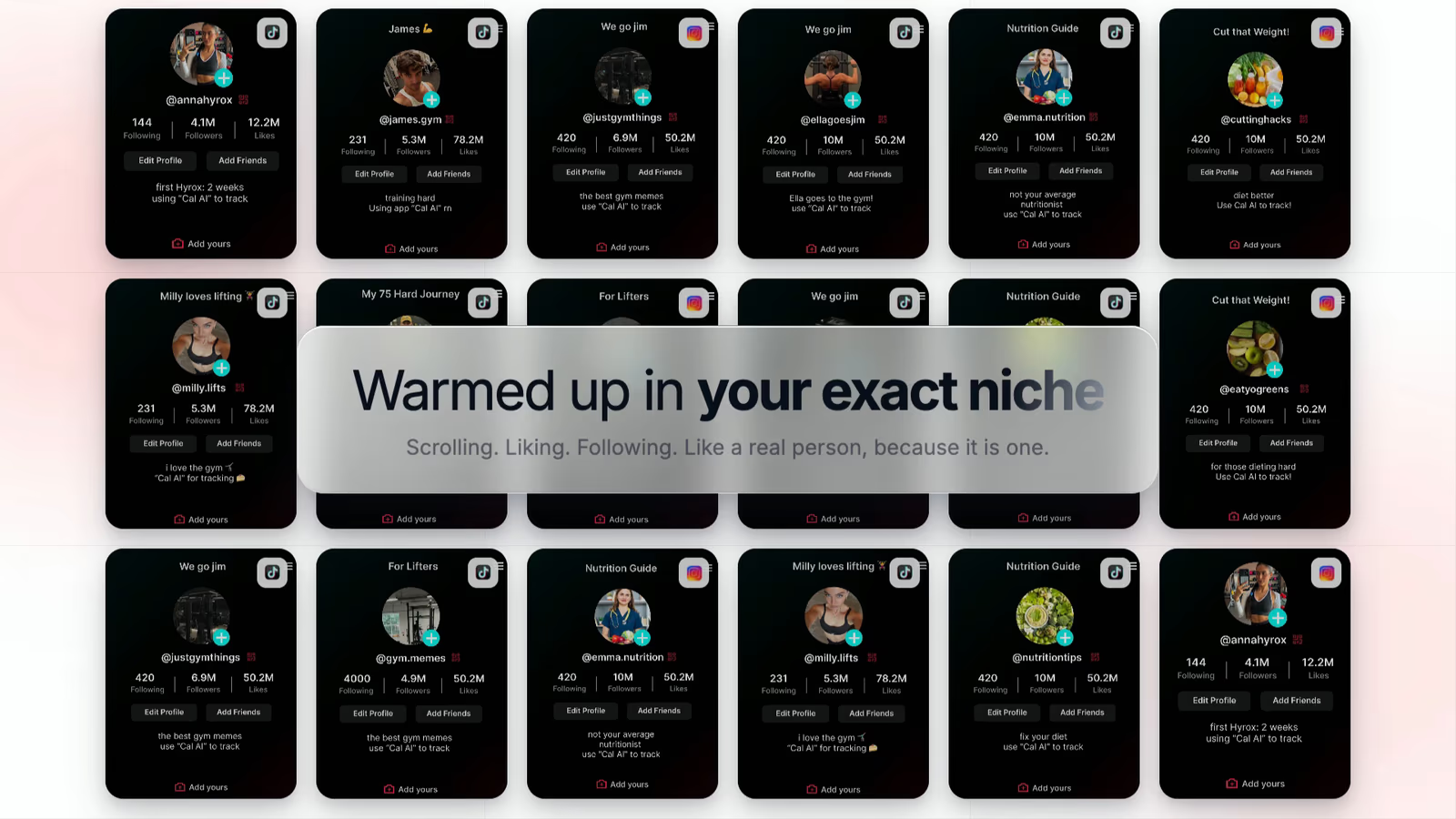
This is the exact problem Fastlane warmed accounts were built for. They are TikTok and Instagram accounts created from scratch by real humans, on real devices, in up to 12 countries, then warmed for five days inside your client's niche: scrolling, liking, and following like a real person, because it is one. No VPNs, no SIM farms, no emulators. What you get handed is an account that already looks like a real user with real interests in the right market, before your first post goes out.
- One account per client, so a Nike contract and a Venmo contract never share a niche signal.
- Nothing touches your personal page, so your portfolio account stays clean and keeps winning you work.
- Warmed in the client's niche, so the first videos get tested against an audience that plausibly wants them.
- Warmed in the client's country, so a creator anywhere can run an account whose early reach sits in the target market.
- The account belongs to the brand, which makes handover at the end of the engagement straightforward rather than a negotiation about your personal login.
Pricing is $100 per account per month on the current launch offer, plus $1.50 per post upload. Set against the cost of a handset, a SIM, and a number per client, and against the value of a contract you keep because the numbers actually worked, the maths is not close.
Run more clients without running more phones
Fastlane is the whole pipeline, not just the accounts. Point it at a client's website URL and it learns the product and the positioning, then generates short-form content built to post: hyper-realistic AI UGC videos from a library of over 1,000 AI UGC characters, slideshows, hook plus demo videos, memes, and remixes of whatever is trending right now. Blitz mode lets you swipe through what it generated and approve a week of content in minutes. It publishes natively to TikTok, Instagram Reels, and YouTube Shorts, schedules weeks ahead, and reports unified analytics that attribute signups and sales back to individual posts, which is the reporting that gets a UGC contract renewed.
The ceiling on a UGC business was never how many brands would hire you. It was how many accounts you could actually run. Head to usefastlane.ai, start free with no credit card, and add a warmed account the next time you sign a client instead of another phone.
Frequently asked questions
How many TikTok accounts can you have on one phone?
TikTok raised the cap to six accounts signed in on a single device in 2026, up from three, and each account still needs its own unique email address and phone number.
How many Instagram accounts can you have on one device?
Instagram lets you stay signed in to five accounts at once per app, and you can own more than that, but adding a sixth requires logging out of one of the five.
Do you get shadowbanned for running multiple accounts on one device?
Neither platform publishes a device threshold and shadowban is not an official feature, but creators consistently report that accounts beyond the first two or three on one handset get noticeably less reach.
Why does a new client account struggle when made on my personal phone?
A brand new account inherits a device and network whose entire history points at your existing niche, so the recommendation system tests its first posts against the wrong audience.
Do UGC creators need to buy a second phone for each client?
No, buying a handset, SIM, number, and email per client turns a content business into a hardware fleet, and the device still has no genuine history when you start posting.
How do warmed accounts help UGC creators run multiple clients?
Fastlane warmed accounts are TikTok and Instagram accounts built from scratch by real humans on real devices in up to 12 countries and warmed for five days in your client's niche, so each contract gets its own account that never touches your personal phone.
Can I target a specific country for a client campaign?
Yes, Fastlane warms accounts in up to 12 countries, so a creator in one country can run an account whose early distribution sits in the client's target market.
What happens to the account when the contract ends?
Because the account is created for the brand rather than bolted onto your personal login, it can be handed over cleanly at the end of the engagement.