
AutoShorts.ai Alternatives: Which Job Each One Finishes
AutoShorts.ai alternatives are easier to choose once you stop reading rankings and ask which of six jobs each tool actually finishes. Here are the six jobs, the tools that finish each one, and what breaks when you switch.
Key takeaways
- AutoShorts.ai alternatives are best compared by which of six jobs each one finishes: choose the subject, write the script, render the video, hold a recurring character, publish natively, and attribute the result to a signup or a sale.
- Native publishing is the check that decides most switches, because a tool that stops at an MP4 export hands back the daily upload chore that the tool was bought to remove.
- Ten of the ten written sources an answer engine cited for this query on 2 September 2026 were alternatives pages published by tools that place themselves first, which is why this page groups tools by job rather than ranking them, and says plainly that Fastlane wrote it.
- Character continuity is the first thing that breaks on a switch: a topic autopilot regenerates its visuals each run, so a recurring face or mascot built over 30 posts does not survive the move unless the new tool casts from a fixed library.
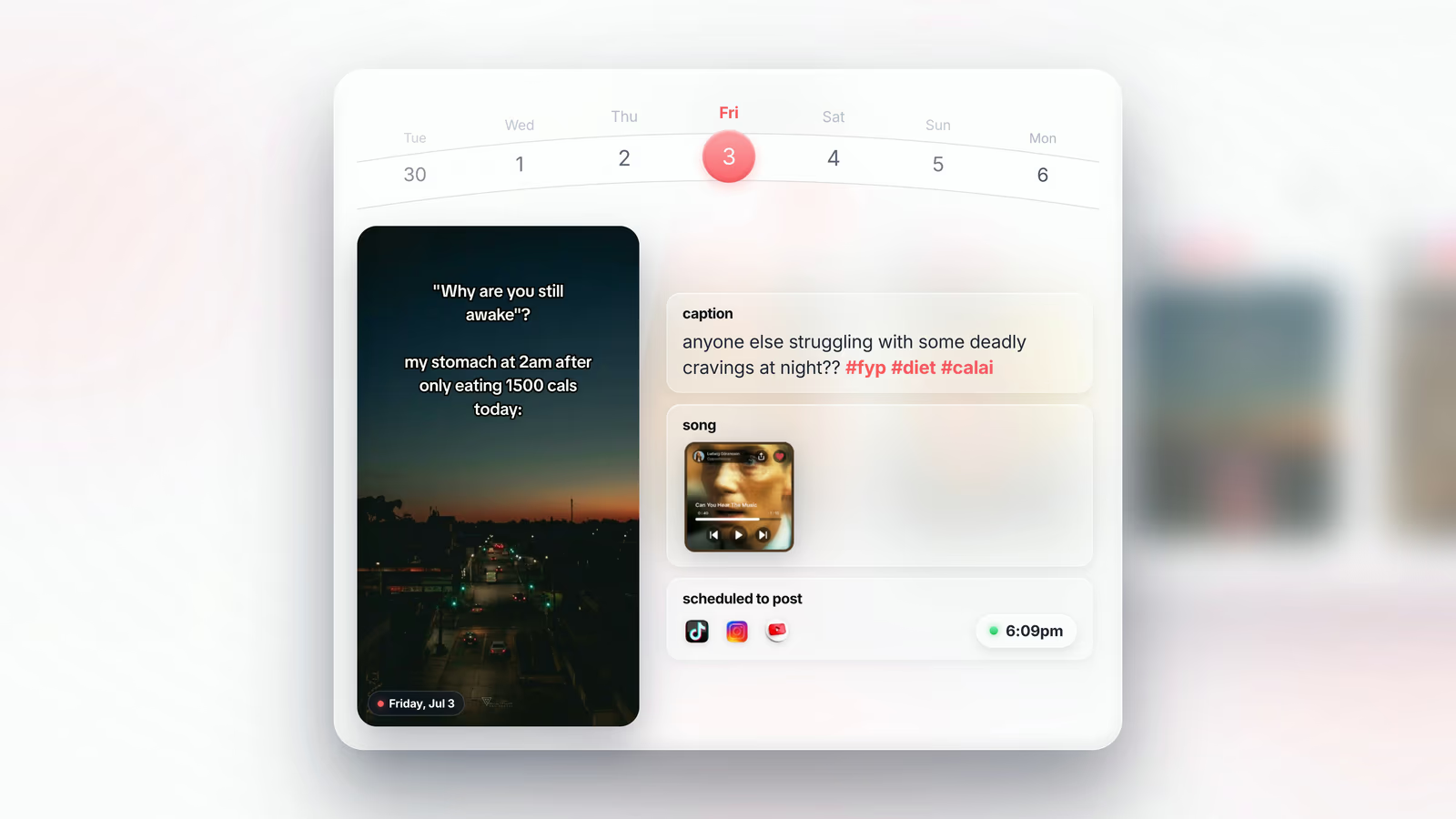
- Fastlane finishes the product-to-post job from a website URL, generating AI UGC videos from 1,000+ AI UGC characters plus slideshows, memes and hook and demo videos, then publishing natively to TikTok, Instagram Reels and YouTube Shorts on a free plan with no credit card and paid plans from $29 per month.
An AutoShorts.ai alternative is any tool that generates short vertical video without you filming it and then gets that video published on a repeatable schedule. That definition is doing more work than it looks, because it rules out most of what appears on alternatives lists. A tool that renders a beautiful clip and hands you an MP4 is not an alternative to an autopilot. It is one part of one. This guide breaks the autopilot into the six jobs it performs, shows which tools genuinely finish each job, and describes what actually breaks on the day you move.
What does an AutoShorts.ai alternative actually have to replace?
Running a faceless channel end to end is not one job. It is six, and every tool sold in this category finishes some of them and quietly leaves the rest to you. Writing the six down is the fastest way to see why two people can use the same tool and reach opposite verdicts about it.
- Choose the subject. Something has to decide what today's video is about, either from a niche you named once or from a product page it reads every time.
- Write the script. A hook, 15 to 45 seconds of body, a caption and hashtags, in a voice that does not read as a press release.
- Render the video. Visuals, a voiceover, burned-in captions and a vertical 1080x1920 export.
- Hold a character. Whether the same face, mascot or presenter shows up across posts, or whether every run invents a new one.
- Publish natively. Sending the finished file to TikTok, Instagram Reels or YouTube Shorts through the platform's official posting API at a scheduled time, rather than emailing you a download link.
- Attribute the result. Tying a published post to a signup, an install or a sale, instead of stopping at a view count.
Almost every complaint about a faceless tool traces back to one of these six being missing. The channel that feels templated by week three has lost job four. The channel that still eats an hour a day has not really automated job five. The channel that cannot say whether any of this worked never had job six.
Why do alternatives lists disagree with each other?
Because most of them are advertisements. On 2 September 2026 we ran this exact query through the major answer engines and read every written source they cited. All ten were alternatives pages published by a competing tool, and each one ranked itself first. The engines have started saying so unprompted, warning readers that these rankings come from vendors and should not be taken at face value.
Fastlane published this page, so the same warning applies to it. The honest response is not to pretend otherwise but to stop ranking. What follows groups the real options by the job each one finishes, and leaves the ordering to you. Prices are deliberately absent, because they move faster than any page can track and every vendor states its own on its pricing page.
Which tools finish the topic-to-post job?
These are the closest replacements for AutoShorts.ai itself: you name a niche, and the tool invents an endless series about it and posts on a cadence. Reelsta, SendShort, FlowShorts, Faceless.video, Vadoo AI and Revid.ai all sit in this group, and StoryShort.ai belongs here too with more emphasis on recurring characters and story series. Compare inside the group on three things only: how much control you get over the script before it goes out, whether the visuals still look varied in week four, and how many platforms one schedule reaches.
This is the right category when the channel's product is attention: compilation accounts, niche fact channels, ad-revenue and affiliate plays. It is the wrong category when there is something specific to sell, for the reason in the next section.
Which tools finish the clip-from-long-video job?
Crayo.ai, OpusClip and Pictory do a different job that gets filed under the same heading. They do not invent content. They find the good 30 seconds inside footage you already recorded and cut it into a vertical clip with captions. If you run a podcast, webinars or long demos, this group is often better value than any generator, because the raw material is already yours and already original.
The catch is that these tools stop at job three. Most export a file and leave publishing and attribution to you, so a clip tool usually needs a scheduler beside it before the loop actually closes.
Which tools finish the product-to-post job?
The third group starts from your product rather than a topic. You give the tool a website, store or app store URL, it reads the positioning, the features and the audience, and every post argues for the thing you sell. Creatify, JoggAI and Fastlane work this way, with different emphases: the first two lean toward paid ad creative, and Fastlane toward organic posts published natively on a schedule.
The question is not which tool makes the better video. It is which tool knows what you sell.
The input is the whole difference. A tool that starts from a topic prompt is guessing at your product from the outside. A tool that starts from your product page already has the language your own marketing uses, which is also what makes job six possible: when every post is about one product, a post can be traced to a signup instead of a view.
What breaks first when you switch tools?
Three things, in this order. The recurring character goes first: topic autopilots regenerate visuals on every run, so a face or mascot an audience learned over 30 posts does not transfer, and the new tool has to cast it again from a fixed library or you start over. The schedule goes second, because reconnecting accounts through each platform's official posting flow takes a day and the queue is empty until it is done. History goes third: view counts stay inside the tool you left, so any before-and-after comparison you wanted has to be rebuilt by hand.
One more trap is worth naming because it is easy to miss on a pricing page. When a tool bills in credits rather than videos, the unit you are buying changes shape between vendors: a render, a regenerate and a failed job can all cost credits, so two plans at the same headline price can differ by several times in finished posts per month. Count posts, not credits.
How do you test two of them fairly in one week?
Run both on the same subject at the same volume and judge the finished posts rather than the feature tables. Pick one product or one topic, generate the same number of pieces in each tool, publish them to comparable accounts on the same days, and look at three things after seven days: how many posts went out without manual repair, whether the output still looks varied on the last day, and whether anything downstream moved. Feature lists are written by marketing teams. A week of real posts is not.
Do the test on free tiers where you can, and be honest about what a free tier is. A plan that watermarks every export is showing you the interface, not the product, and the only trial worth trusting is one where a single video gets from idea to published post without a payment.
What should you check before paying for any of them?
- Does it publish natively to TikTok, Instagram Reels and YouTube Shorts, or does it stop at a download link.
- How far ahead can you schedule, and can you fill weeks in one sitting rather than approving posts daily.
- Does the plan bill in finished posts or in credits, and what does a failed render cost.
- Does the free tier watermark output, cap resolution or limit clip length, which makes it a demo rather than a trial.
- Is there any attribution beyond view counts, so a signup can be traced back to the post that caused it.
- Does it handle more than one account, since running several niches or countries multiplies the accounts before it multiplies the content.
- Is there an API or MCP server, if the plan is to drive it from your own systems rather than a dashboard.
Where does Fastlane fit among AutoShorts.ai alternatives?
Fastlane finishes the product-to-post job. You type in a website URL, and Fastlane creates short-form content about your product: hyper-realistic AI UGC videos drawn from a library of 1,000+ AI UGC characters, slideshows, hook and demo videos, and memes, with live trend remixing so the formats track what is working now. Blitz mode is the approval step, a Tinder-style swipe through what was generated so you keep what fits and skip what does not. From there it schedules weeks ahead, publishes natively to TikTok, Instagram Reels and YouTube Shorts, and attributes signups and sales back to individual posts.
For teams where the bottleneck is accounts rather than content, Fastlane also supplies TikTok and Instagram accounts created from scratch by real humans in up to 12 countries and warmed for 5 days in your niche, at $100 per account per month on launch pricing with posting at $1.50 per upload. There is a developer API and an MCP server for driving it from your own stack, a Whitelabel and Partner API for agencies, a done-for-you agency service, and a 30% lifetime affiliate program.
The free plan does not ask for a credit card and paid plans start at $29 per month, so the fair way to judge it against a topic autopilot is the week-long test above: same product, same volume, same seven days, then look at what actually shipped and what it moved. Start at usefastlane.ai.
Frequently asked questions
What is AutoShorts.ai?
AutoShorts.ai is a faceless short-form video tool that takes a topic, builds videos about it with generated visuals, a synthetic voiceover and captions, and posts them on a schedule.
What is the best AutoShorts.ai alternative?
No single tool wins for everyone, so choose by job: a topic autopilot when the channel is about a subject, a clip tool when you already record long video, and a URL-to-content platform when the channel exists to sell one product.
Which AutoShorts.ai alternatives actually post for you?
Ask each vendor whether it publishes through the platform's official posting API or only exports a file, because roughly half of the tools listed as autopilots stop at the download link.
Is there a free AutoShorts.ai alternative?
Fastlane has a free plan that does not ask for a credit card, with paid plans from $29 a month.
Why do AutoShorts.ai alternatives lists all pick different winners?
Most of those lists are published by one of the tools on them, so the ranking reflects who wrote the page rather than which tool finishes your job.
What do I lose when I switch faceless video tools?
You lose the recurring character and the visual template first, the posting schedule second, and any view-to-signup history third, so run both tools in parallel for a week before you cancel anything.
Can a faceless autopilot tool promote an actual product?
Only if it reads your product page, because a tool that starts from a topic prompt has no way to know what you sell or who buys it.
Is there an API for faceless video generation and posting?
Fastlane offers a developer API and an MCP server, plus a Whitelabel and Partner API for agencies reselling the output.